

Nineteen dolphins died in a month on the coast of Anapa.
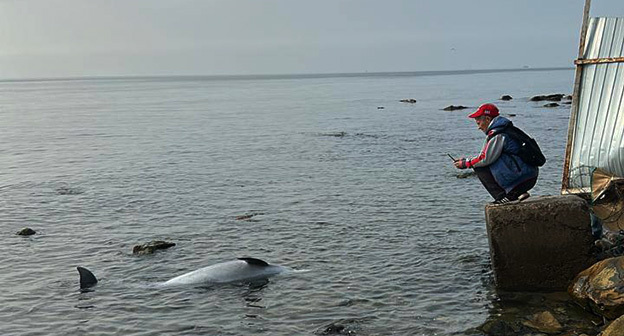
The number of dead dolphins in the Anapa district has almost tripled compared to 2023. Specialists from the Delfa Center indicated that the deaths of the cetaceans could have been caused by pollution of their habitat due to a fuel oil spill.
"Caucasian Knot" reported that in mid-April, environmentalists reported the deaths of more than 120 dolphins due to a fuel oil spill in the Krasnodar Territory. Typically, the stranding season for cetaceans in the Black Sea lasts from March to June. This is due, in part, to the animals' weakened immune systems after the winter. However, this process is occurring amid the aftermath of a massive fuel oil spill.
On October 23, Kuban authorities announced that a fuel oil slick weighing up to 900 tons was moving across the Black Sea toward the shores of Anapa and the Temryuk district. Restoration of coastal embankments and ditches has begun. Over the course of four days, from October 22 to 26, a 23-kilometer protective embankment was erected along the main beaches in Anapa.
Over the past month, starting on October 21, an increase in the number of dead cetaceans stranded in the Anapa district (before this date, there were practically no strandings) has been observed. 19 individuals - eight bottlenose dolphins, five common dolphins, and six Azov dolphins - were stranded, the Delfa dolphin rescue center reported.
It is noted that in 2024 and 2023, during the same period, there were only eight and six dead dolphins, respectively.
No such increase in the number of dead dolphins has been observed in other areas of the Krasnodar Territory.
"Is the current surge in dolphin mortality related to the fuel oil spill recorded in It's impossible to say for sure whether the accident occurred around October 20th of this year in the waters off Anapa or was a coincidence. One thing is clear: such severe pollution of the dolphin habitat cannot occur without consequences for all three species of Black Sea cetaceans. The gradual accumulation of toxicants can have a significant impact on their health, especially their immune system," Delfa emphasized.
According to experts, it's quite possible that they are already experiencing these very consequences.
For example, the common dolphin that died on October 21st was diagnosed with a chronic infection. Numerous granulomas in the lungs, enlarged lymph nodes, petechial hemorrhages in the gastrointestinal tract, and extreme emaciation of the animal indicated this.
Environmental activists stated that the study of biomaterials is "a long but necessary process, since in addition to understanding the causes of infectious diseases and the death of wild animals, and further prognoses of survival, it is important to be able to effectively and promptly diagnose these diseases in order to provide assistance to living cetaceans."
Scientists from the Subtropical Center of the Russian Academy of Sciences, based on the results of a study of coastal waters affected by the fuel oil spill, reported in August that the concentration of oil products near Vityazevo had normalized, but noted a change in the chemical composition of macroalgae and the impact of fuel oil on the mussel population.
Authorities assure that traces of fuel oil were not found in fish caught in the Black Sea after the large-scale Oil pollution of the waters. Environmentalists warn that eating seafood and fish caught in the contaminated area is unsafe in the near future. Environmentalists question claims that Black Sea fish are safe.
As a reminder, on December 15, 2024, two tankers carrying fuel oil sank in the Kerch Strait. A crew member of one of the tankers died as a result. In addition, an oil spill occurred, leading to catastrophic environmental consequences, according to the "Caucasian Knot" report "Fuel Oil Spill in the Kerch Strait".
Materials on the consequences of the fuel oil spill have been collected by the "Caucasian Knot" on the page "Eco-disaster in Kuban".
"Caucasian Knot" also reported that, over the next two years, Kuban authorities planned to transfer more than 439 million rubles to the budgets of Anapa and the Temryuk District for the restoration of beaches after the fuel oil spill.
Translated automatically via OpenAI from https://www.kavkaz-uzel.eu/articles/417608




![Tumso Abdurakhmanov. Screenshot from video posted by Abu-Saddam Shishani [LIVE] http://www.youtube.com/watch?v=mIR3s7AB0Uw](/system/uploads/article_image/image/0001/18460/main_image_Tumso.jpg "Tumso Abdurakhmanov. Screenshot from video posted by Abu-Saddam Shishani [LIVE] http://www.youtube.com/watch?v=mIR3s7AB0Uw")