


"Nowhere to hide": key points of the report by UN Special Rapporteur Marianna Katsarova
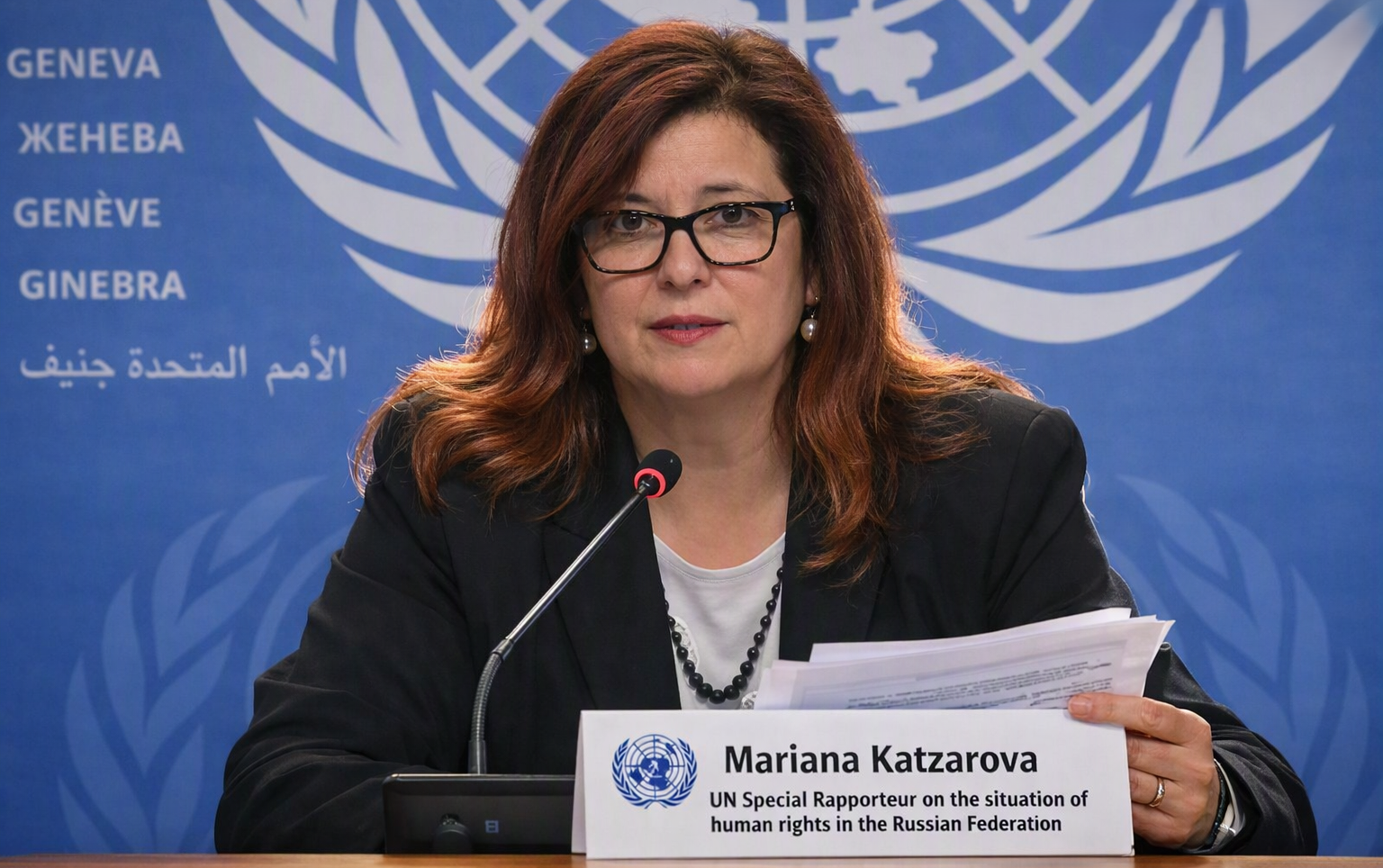
The UN Special Rapporteur on the situation of human rights in the Russian Federation, Marianna Katsarova, in a report presented on September 21, 2026, to the Human Rights Council, analyzes the practice of transnational repression, which she links to the Russian authorities.
On September 21, 2026, the UN Special Rapporteur on the situation of human rights in the Russian Federation, Marianna Katsarova, in the report "Nowhere to hide," stated that the Russian Federation has created a state system of surveillance, intimidation, and punishment of its critics abroad, as well as pressure on their families in Russia. She characterized Russian transnational repression as a violation of international law that threatens the sovereignty of host states and must be stopped 1.
What the report says
According to Marianna Katsarova, the Russian authorities use various mechanisms abroad to persecute critics and opponents. The report mentions physical violence and threats, intimidation, surveillance, cyberattacks, pressure on relatives, criminal and administrative prosecution, the use of Interpol, and other mechanisms of international law enforcement cooperation.
The report claims that the practice of transnational repression is systemic and institutionalized. Among the Russian structures that, according to the document, are involved in such actions are the Federal Security Service (FSB), the Main Intelligence Directorate (GRU), the Foreign Intelligence Service (SVR), the Investigative Committee, the Prosecutor's Office, the Ministry of Internal Affairs (MVD), the Ministry of Justice, the Ministry of Foreign Affairs, and other agencies. The author of the report concludes that the Russian authorities are extending their system of internal repression beyond the country's borders to silence and stop any manifestations of dissent and criticism of the Russian authorities. 2.
Increase in persecution after 2022
After the start of the military special operation in February 2022, according to the report, the scale of persecution of Russians abroad and other critics of the Russian authorities has expanded. The document provides data on 29 documented cases in 2014–2021 and 89 cases in 2022–2024. This corresponds to approximately an eightfold increase in the average annual number of recorded cases.
In total, the report examines nearly 400 cases of transnational repression. According to the data provided by Katsarova, between February 2022 and now, between 650,000 and 900,000 people have left Russia. Among them were activists, journalists, human rights defenders, lawyers, and those who refused military service.
Among the tools used by the Russian authorities abroad, the report mentions criminal cases and absentia sentences, requests for extradition and international wanted notices, Interpol mechanisms, financial restrictions, digital surveillance, and pressure on relatives. The number of absentia sentences, according to the data presented in the report, increased from four in 2022 to 157 in 2025.
What methods are used
The methods described in the report include physical violence and threats, intimidation, surveillance, cyberattacks, criminal and administrative prosecution, as well as the use of international law enforcement mechanisms.
A separate focus is on pressure on the relatives of people abroad. According to the Special Rapporteur, such actions may be used to influence critics of the Russian and Chechen authorities. The document cites cases of relatives of Tumso Abdurakhmanov* and Hasan Khalitov*, who, according to the report, were kidnapped and detained. The Special Rapporteur considers these cases in connection with pressure on bloggers due to their criticism of the Chechen authorities.
The report also examines the use of Russian administrative and financial mechanisms abroad. Russian lists of individuals accused of terrorism or extremism may be used by foreign financial and compliance systems, which, according to the document, creates additional obstacles for critics of the Russian authorities abroad.
The document also discusses strategic lawsuits against public participation (SLAPP), which may be used to pressure journalists and human rights defenders abroad.
The Caucasus region in the report
The Caucasus is examined in the report as one of the regions where cases of transnational persecution related to the Russian authorities and Chechen power structures have been recorded.
Among the most well-known episodes is the murder in Berlin in 2019 of Chechen opposition figure and Georgian citizen Zelimkhan Khangoshvili. A German court established that the murder was ordered by the Russian authorities.
In the context of the persecution of the Chechen diaspora, the report discusses the murders of Zelimkhan Khangoshvili in Germany, Imran Aliev in France, and Mamikhan Umarov in Austria, as well as the attack in 2020 on Tumso Abdurakhmanov* in Sweden.
Persecution of North Caucasian activists
The use of international law enforcement mechanisms against Chechen and other North Caucasian activists is examined separately.
Mansur Movlaev, a critic of Ramzan Kadyrov, was detained in Kazakhstan based on a Russian request. The report also mentions his previous reports of kidnapping, detention, and torture by Chechen security forces.
Chechen political refugee Andemirkan Guchayev was reportedly detained in Italy under a red notice from Interpol. Circassian activist Hasan Matuev from Kabardino-Balkaria was reportedly detained in Turkey at the request of Russia.
Regarding Armenia, the report cites cases of detention of Russian dissidents and anti-war activists. The case of Dmitry Setrakov is examined separately, who, according to the report, was kidnapped in Armenia by Russian military personnel after leaving the Russian army in December 2023.
Armenia and Georgia are also named among the countries where, according to reports cited in the document, Russian special services are monitoring Russians and other citizens. According to the Special Rapporteur, such surveillance may be accompanied by subsequent persecution or attacks.
Pressure on families and relatives
The report separately cites cases of pressure on the relatives of activists. Regarding the relatives of Tumso Abdurakhmanov* and Hasan Khalitov*, it mentions kidnappings and detentions.
The case of Zarema Musaeva, the mother of pressure on the Yangulbaev family. The European Court of Human Rights previously established violations of her rights.
The document also provides data on the detention of relatives of the Yangulbaevs. According to the information presented in the report, at least 37 relatives of the family were detained by December 2021.
In June 2026, according to the report, Mansur Movlaev's parents were kidnapped, and his brother was tortured. The Special Rapporteur considers these actions as a means of pressure related to Movlaev's case when he was in Kazakhstan and sought to prevent his extradition to Russia.
According to Katsarova, until 2022, documented cases of pressure on relatives outside Chechnya were less frequent, but subsequently, such reports became more numerous. In relation to Chechnya, such practices, according to the report, have a longer history.
Interpol and international cooperation
The report examines the use of international law enforcement cooperation to persecute critics of the Russian authorities abroad. Among such tools are requests for extradition, international wanted notices, and Interpol mechanisms.
According to the Special Rapporteur's conclusions, Russia uses international mechanisms to continue persecuting people outside its territory. From 2004 to 2025, according to the report, at least 140 incidents related to Russia were recorded concerning citizens of seven countries, including detentions, extraditions, kidnappings, and enforced disappearances.
Responsibility of the Russian authorities
According to the Special Rapporteur's conclusions, there are no effective mechanisms in Russia to hold accountable those responsible for actions related to transnational repression. The report discusses the difficulties in establishing individual responsibility, including due to the use of intermediaries.
As an example of pressure on organizations documenting human rights violations, the report examines the measures taken by the Russian authorities against the project "OVD-Info"*, which has been designated as a foreign agent and included in the list of terrorists and extremists.
According to the data provided by the Special Rapporteur, Russia ranks third among states in terms of the number of recorded direct physical acts of transnational repression over the past decade. This refers specifically to physical attacks, not all forms of transnational persecution.
What the Special Rapporteur recommends
The Special Rapporteur recommends that Russia cease practices that she qualifies as transnational repression and repeal norms used to persecute critics of the Russian authorities.
Host states are encouraged to create mechanisms to protect people subjected to transnational persecution, carefully scrutinize Russian requests for extradition and international wanted notices, investigate threats and attacks, and prevent the use of their law enforcement and financial mechanisms to persecute people for political reasons.
The report also discusses the principle of non-refoulement. According to the Special Rapporteur's position, states should not transfer a person to Russia when there is a justified risk to their life, torture, inhumane treatment, or a blatant denial of justice.
Katsarova also suggests considering transnational repression primarily in the context of human rights protection, rather than solely as a national security issue. The report notes that a state may be held responsible for the actions of its representatives abroad when it has the relevant authority or control over the affected individuals.
The recommendations are addressed to Russia, states hosting victims of transnational repression, UN member states, Interpol, banks and international financial institutions, financial regulators, database operators, and regional human rights bodies.
The Special Rapporteur also urges the UN to develop international standards in this area, including a legally binding international treaty on transnational repression.
Notes
* included by the Russian Ministry of Justice in the register of foreign agents.
- "Nowhere to hide": The UN Special Rapporteur exposes Russia's global campaign of transnational repression and calls for the adoption of a legally binding UN convention // ohchr.org, 21.09.2026.
- https://www.ohchr.org/sites/default/files/documents/hrbodies/hrcouncil/sessions-regular/session63/a-hrc-63-60-unofficial-translation-r.pdf
Translated automatically via OpenAI from https://www.kavkaz-uzel.eu/articles/427072


![Tumso Abdurakhmanov. Screenshot from video posted by Abu-Saddam Shishani [LIVE] http://www.youtube.com/watch?v=mIR3s7AB0Uw](/system/uploads/article_image/image/0001/18460/main_image_Tumso.jpg "Tumso Abdurakhmanov. Screenshot from video posted by Abu-Saddam Shishani [LIVE] http://www.youtube.com/watch?v=mIR3s7AB0Uw")