


Lawyers assessed the legal consequences of the conflict with tourists in Kakheti.
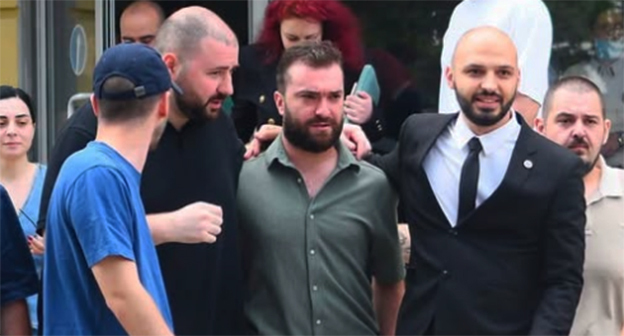
Georgy Chigladze, who hit a Russian-speaking girl, risks receiving a fine or a suspended sentence, as the motive for the conflict on national grounds is difficult to prove.
As reported by "Caucasian Knot", the beating of a Russian-speaking tourist by Georgian resident Giorgi Chigladze caused a stir on social media. Georgian police stated that Chigladze attacked the tourist due to an insult directed at wedding participants. The victim's friend claims that the conflict arose because of the Russian language. A march took place in Tbilisi, where participants expressed support for Chigladze. The court in Telavi released Chigladze on bail. In court, he stated that he regretted what happened. Georgian media reported that the victim holds citizenship of Russia and Turkey. In the recording that preceded the beating of the tourist by a wedding participant in Telavi, the girl waves to the wedding participants from the window, but in response, she faces accusations of having splashed water on the equipment and insults. The victim herself stated that they did not provoke the wedding participants.
The Ministry of Internal Affairs of Georgia reported, citing witnesses, that during the wedding celebration at one of the hotels in Telavi, the hotel tourists insulted the wedding participants from their hotel balcony and splashed water on the equipment from which music was playing. Subsequently, Georgian resident Giorgi Chigladze struck one of the tourists. She was taken to a clinic, and Chigladze was detained. In a letter from the detention center, he expressed regret for having succumbed to emotions. "I am very sorry that this woman was hurt, but I did not want this," Chigladze wrote, in particular.
Article 120 of the Criminal Code, under which charges were brought, provides for several types of punishment, including a fine, corrective labor for up to six months, house arrest, and imprisonment for a term of one to three years.
"Considering that the prosecution requested the application of a preventive measure in the form of bail for Chigladze, and the court granted this request, it can be assumed that if he is found guilty, the punishment will most likely be a fine," said Georgian lawyer Mariam Kvelashvili, who is not connected to the case involving the tourists.
"As for the admission of guilt and remorse, certainly, if the court ultimately concludes that Chigladze indeed committed a crime, these circumstances will be taken into account when determining the punishment as mitigating factors. The defense's position that he became a victim of provocation cannot serve as a basis for mitigating punishment and is not considered by law as a mitigating circumstance," Kvelashvili believes.
At the same time, she noted that the fact that he also had bodily injuries requires legal assessment. "It is necessary to establish whether these injuries were inflicted on him in the course of necessary defense or, as the defense claims, whether violence was applied to Chigladze beforehand," Kvelashvili explained in a comment to a correspondent of the 'Caucasian Knot'.
The version that the conflict occurred on the grounds of ethnic hatred is extremely difficult to prove, as it is necessary to establish that the accused acted out of hatred towards representatives of a particular nationality, the lawyer believes.
"Based on the facts of the case, such circumstances are not apparent. On the contrary, there are grounds to believe that the conflict was provoked by the actions of the victims, rather than their ethnic origin," Kvelashvili summarized.
Another Georgian lawyer, Shota Makatsaria, also believes that the court will most likely limit itself to a fine. "There is a single video recording showing that this guy hit the girl in the face, and of course, there will also be the testimony of her friend. This is absolutely enough to issue a verdict," he said.
"Of course, if there are qualifying factors under Article 117, this already threatens a harsher punishment. In this case, he could be sentenced to imprisonment for a term of 3 to 5 years. But it needs to be proven that the conflict started on the grounds of hatred based on nationality, and not for other reasons," Makatsaria pointed out.
In his opinion, claims that the girls provoked the conflict will not, in themselves, be a mitigating circumstance for Chigladze. "This may be grounds for a separate case. The actions of the girls may fall under an article like petty hooliganism. In Georgia, this usually results in a fine. But even if a case is initiated against them, it will not mitigate Chigladze's situation in any way," Makatsaria believes.
The bail amount of 5,000 lari, according to him, exceeds standard norms. "This is an unusual bail amount. A bail of 1,000 lari can be set, and in such a situation, it is most often 2,000 lari," the lawyer noted.
The investigation, according to one of the participants in the incident that occurred in the hotel room in Telavi, confirmed that the girls did not splash water on the wedding guests, did not insult them, and did not damage the equipment.
Political scientist Archil Sikharulidze believes that Georgian society has indeed divided into several parts due to the incident. "Some declared him a hero, others – someone who committed violence against a woman, and others – an inadequate nationalist. But in general, neither the judicial system nor the authorities are satisfied with turning him into a hero, and putting him in prison would mean declaring him as such. In this logic, a fine or a suspended sentence fits," Sikharulidze explained.
Translated automatically via OpenAI from https://www.kavkaz-uzel.eu/articles/425259




![Tumso Abdurakhmanov. Screenshot from video posted by Abu-Saddam Shishani [LIVE] http://www.youtube.com/watch?v=mIR3s7AB0Uw](/system/uploads/article_image/image/0001/18460/main_image_Tumso.jpg "Tumso Abdurakhmanov. Screenshot from video posted by Abu-Saddam Shishani [LIVE] http://www.youtube.com/watch?v=mIR3s7AB0Uw")