

Witnesses reported a shortage of security forces at Makhachkala airport during the first hours of unrest.
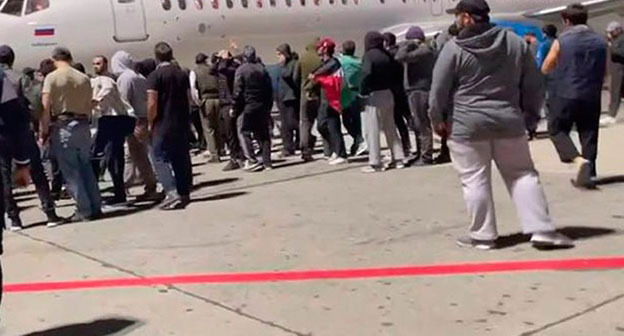
In the first hours when rioters began arriving at Makhachkala Airport on October 29, 2023, there were just over a hundred security forces there, some without shields, helmets, or batons. They were unable to contain the onslaught of the crowd, which had arrived at the airport searching for the Israelis, according to court testimony.
As reported by the "Caucasian Knot," three alleged organizers of the pogrom—Ilya Ponomarev*, Abakar Abakarov, and Israil Akhmednabiyev (Abu Umar Sasitlinsky)—were placed on the wanted list in connection with the riots at Makhachkala's Uytash Airport. According to the Investigative Committee, they published posts on Telegram that encouraged residents of Dagestan to participate in mass riots motivated by hatred towards Israel. In July 2025, the cases of all three were submitted to the Supreme Court of Dagestan for trial in absentia. Participants in the riots that took place in 2023 at Makhachkala's Uytash Airport attempted to disarm security forces and threw stones at them, according to witness testimony read out in court in November 2025. Abakarov was killed in Turkey in October 2025, after which the court sent a request to Turkey to confirm his death.
Mass riots at Makhachkala Airport occurred on October 29, 2023, following a report of the arrival of a plane carrying passengers from Israel. More than 20 people were injured in the riots. 1,200 people were brought to administrative responsibility.
More than 130 people have already been convicted of participating in the mass riots at Makhachkala Airport, receiving prison terms ranging from 6.5 to 15 years. Dagestani resident Bakhtiyar Radzhabov, whom the Georgievsk City Court sentenced to seven years in prison in October, became at least the 136th person convicted for participating in the pogrom; Investigators previously stated that the cases of 139 defendants (excluding three who are wanted) had been transferred to the courts. "A Wave of Anti-Semitic Actions in the North Caucasus".
The pogrom at Makhachkala's Uytash Airport on October 29, 2023, became the largest riot in the North Caucasus in the first half of the 2020s. However, many details of the incident remained hidden until now, and only occasionally emerged in the form of media reports about certain testimonies during the trials. A "Caucasian Knot" correspondent managed to find a source that provides a complete picture of the events as seen by the investigation. This source turned out to be the verdict of the Petrovsky District Court of Stavropol Krai, where a group of pogrom participants was tried on March 21, 2025, in case No. 1-7/2025 (1-180/2024) dated March 21, 2025.
The names of those who testified have been removed from the document and replaced with the faceless "Full Name (number)". Some of the names were recovered due to the fact that they involved people of relatively high rank, but most remained anonymous.
Lack of Security Forces

The first thing the document shows is that Dagestani security forces seriously misjudged the scale of the upcoming rally. Airport director Said Ramazanov explicitly noted that the first protest at the airport, which took place on October 12, 2023, when several people simply stood with Palestinian flags, served as a reference point.
“At that time, no one had reliable information about the number of people planning to come to meet the flight from Israel or about their plans. "The most everyone assumed was that there would be a peaceful demonstration with Palestinian flags, after which the people would disperse," the document quotes the head of the airport police department as saying.
No one noticed that the situation had changed towards radicalization, as demonstrated by the rallies in Khasavyurt the day before.
In Khasavyurt, hundreds of people gathered outside a hotel after social media reports that the hotel was housing refugees from Israel, according to the "Caucasian Knot" report "Anti-Semitic Actions in the North Caucasus: How It Happened".
How the decision to send security forces to the airport was made is evident from the testimony of the head of the department for the organization of public order protection and interaction with executive authorities of the constituent entities of the Russian Federation, cited in the verdict. Mikail Makasharipov, the Ministry of Internal Affairs of the Republic of Dagestan, and local government bodies. According to him, at approximately 12:00 PM on October 29, he received a call from Interior Minister Abdurashid Magomedov, who informed him of a possible rally and ordered him to "go to the airport..., monitor the situation, and, if necessary, organize public order maintenance" and prepare a force and resources assessment to ensure security and maintain order at the airport. Since nothing extraordinary was anticipated, Makasharipov included 50 Rosgvardia soldiers, 105 police officers, four traffic police crews, and two escort battalion crews in his request.
Makasharipov himself arrived at the airport between 3:00 PM and 4:00 PM and ordered the police officers already there, fully equipped—with shields, helmets, and rubber batons—to "stand at the approaches to the airport and control the situation." By 6:00 PM, the number of various security personnel—police, National Guard officers, and riot police—had reached 120-130, but at least a third of them were only in "uniform," meaning they lacked the necessary equipment.
The deputy head of the Linear Police Department (LPD) at Makhachkala Airport recalled that he began to notice large gatherings of people with Palestinian flags around 6:00 PM. While their numbers were small, line police officers simply escorted them out of the airport. At the same time, the airport's general director, Said Ramazanov, planned to escort passengers out of the arrivals area through a service entrance, bypassing the station square, or through the construction exit of the new runway, to avoid encountering the protesters.
But after the number of people gathered in front of the airport began to grow exponentially – according to Makasharipov's estimates, it grew from approximately 200 to 1,500 between 6:30 and 7:00 PM – these forces were clearly insufficient for any active measures, let alone defense.
When, at approximately 7:00 PM, the crowd raised Palestinian flags, moved out onto the roadway, and began stopping and inspecting departing vehicles, the police were unable to detain them because, as Makasharipov noted, "their total number significantly exceeded the number of law enforcement officers." All he could do was station riot police and police officers near the barriers at the airport entrance and request reinforcements.
Another commander noted that he was short of men, and that arriving protesters "easily bypassed their barrier."
Maksharipov's deputy, Ruslan Mustafayev, clarified his superior's testimony, noting that the conversation with him about training people to guard the airport took place at 11:00 a.m. and that the request listed approximately 170 people. Moreover, according to him, Makasharipov told him as early as 5:00 PM that "a large number of civilians were gathering at the airport, unrest was starting to break out, and the situation could get out of control."
The head of one of Makhachkala's police departments, whose officers had previously been deployed to protect the airport, also noted that problems began to be felt as early as 5:00 PM, when approximately 200 people gathered near the airport and, in his words, were "aggressively inclined." He also stated that he himself had requested reinforcements from his department.
The head of the airport's line police department also stated that he had requested reinforcements from the police department—allegedly as early as the morning of October 29, before the minister's order. When it became clear that events were spiraling out of control, the Dagestan Minister of Internal Affairs promised to send reinforcements at 5:40 PM, following Makasharipov's report. However, as it turned out, the Ministry of Internal Affairs leadership had no reserves on hand, so they sent in anyone they could find.
The severity of the manpower shortage is demonstrated by the list of injured police officers, among whom was a member of the security and escort team at the Buinaksk pretrial detention center, a district juvenile affairs officer, and a junior specialist in the logistics group of the riot police department. Furthermore, the units involved were located in different parts of Makhachkala, and orders did not reach everyone at the same time – some at 6:30 PM, others at 7:30 PM – and therefore they arrived at different times (it took between one and a half and three hours to get ready and travel – according to statements from various participants in the events, arrival times are 8:12 PM, 8:40 PM, 9:00 PM, 9:35 PM, and 10:00 PM). This prevented the security forces from immediately turning the situation around. The head of the Department of Internal Affairs also wrote that reinforcements arrived in small groups, believing that the reason for this was that the roads near Uytash were clogged. Moreover, among the reinforcements that arrived, as Makasharipov noted, some were only in uniform.
Another witness noted that since the event was "preventive," one group of 16 police officers was armed with machine guns and equipped with helmets and bulletproof vests, but did not have "special equipment for mass events (mass riots in particular) - shields, visors, and batons."
Around 9:00 PM, the Minister of Internal Affairs of Dagestan arrived at the airport, and Makasharipov handed over command to him.
Breakthroughs

Around 7:30 PM, the crowd broke through the cordon and entered the airport parking lot. A second line was formed between the airport parking area and Terminal B. However, at 8:30 pm, the crowd broke into the terminal and smashed the glass doors to Terminal B, entering the terminal building, where the rioters "moved chaotically in search of Israeli citizens, disturbing public order," and illegally searched these premises in search of passengers on flight No. WY-4728 from Tel Aviv to Makhachkala - Israeli citizens.
On the first floor of the terminal, the rioters entered the premises belonging to the transport security zone and the restricted access aviation security zone, on the second floor, the premises belonging to the transport security zone and the controlled aviation security zone, as well as the restricted access aviation security zone, which includes: the "departure" border control zone, the "departure" customs control zone, the premises of the border department of the Makhachkala checkpoint of the Border Directorate of the FSB of Russia for the Republic of Dagestan and the customs post.
The third cordon was A line was built between the airport buildings and the runway area, at the fence gates, near the VIP lounge building, to the left of Terminal A. The crowd attempted to break through three times. After the first two attempts were repelled, the crowd broke through this line at around 10:20 p.m., and people ran out onto the runway. However, no one ever broke through the gates located at the junction of the VIP lounge and Terminal A.

People who forced their way onto the apron (airplane parking area) demanded to inspect the plane "in order to find Israeli citizens." The police initially forced the crowd off the platform. Because the gate's locking mechanism had been damaged by the crowd's actions, one officer blocked the gate with his handcuffs. However, the crowd then forced its way back in. The crowd accompanied their actions with shouts of "Get out of the way!" They threw paving stones, stones, sticks, glass bottles, crates, and clods of earth at the police. Many of the crowd were ready to engage in a fight—they tried to snatch away shields and batons, ripped off helmets, tried to knock them to the ground, and grabbed at their uniforms to pull the police out of the cordon.
The verdict recorded the recollections of some of the police officers about their ordeal. Thus, the police sergeant, who was most seriously injured, recalled how his helmet was ripped off, his shield was snatched from his hands, he was thrown to the ground, and "they began to repeatedly punch and kick him on various parts of his body."
Another police officer recalled how he "noticed a young man climbing over a fence." The man then punched him in the neck. The officer responded by using a rubber baton, after which several people ran up to him and began beating him, knocking him to the ground. When he asked another police officer for help and the officer threatened to shoot, people from the crowd subdued him, beat him, and even forced him to apologize (the second police officer confirmed this in his testimony).
In turn, the riot police used tear gas twice – at 8:30 p.m. and at 10:20 p.m., when the crowd was particularly pressing and pushing through the cordon.
The Hunt for the Bus
While the crowd was raging outside, customs officials in Building B were calmly processing the documents of those arriving. According to the deputy head of the customs control center, when one of his subordinates reported to him that a crowd was trying to break into Terminal B, he began asking customs officers to expedite the processing of passengers. However, within 10 minutes, he was forced to simply escort passengers away as the crowd had broken into the terminal and loaded them onto a specially prepared bus, locking the doors behind them to contain the crowd.
Said Ramazanov also noted that when they heard the noise of the approaching crowd, they began urgently escorting passengers to the service area (on the platform) to a pre-prepared bus. The bus departed the terminal toward the delegation waiting lounge (DLL) just minutes before a group of 150-200 protesters broke through the door from International Terminal B and ran after the bus.
Ahead of the crowd, as the deputy head of the LOP recalled, ran a young man with a Palestinian flag.
Airport staff tried to stop the protesters, but, as one witness recalled, "since there were many of them, about 100 people, and there were only 10-15 airport staff on the platform, they were unsuccessful." There were no police or National Guard officers on the platform at the time.
The majority of the airport staff, along with former airport director and State Duma deputy Khizri Abakarov, who had arrived at the airport on his own initiative, ran after the bus to protect passengers from the crowd if possible. A bus maneuvering through a field was stopped near fuel depots and surrounded by a crowd of approximately 100 people.
Said Ramazanov, along with several airport employees, remained on the platform, shielding a family of three and a wheelchair-bound child who had not been loaded onto the bus in time. When the rioters ran after the bus, Ramazanov called a minibus, which took the family to the administrative building, where they remained until evacuated by helicopter. Immediately afterward, he claims, he rushed to the bus, which had stopped a kilometer from the platform – first on foot and then in a search and rescue vehicle.
Later, airport director Ramazanov and the deputy head of the local police department had to eject the rioters from the bus. They then blocked the bus and began throwing stones at it, forcing everyone on board to lie down and duck. The driver was in shock and afraid to continue driving. As Ramazanov recalled, he yelled at the driver, who then started the engine and the bus, literally pushing aside the protesters, reached the ZOLD.
According to the recollections of both the airport director and the deputy head of the LOP, no other law enforcement officers were present while the bus was traveling, although Makasharipov noted that after handing over command to the minister, he decided to participate in assisting with the evacuation of passengers. Said Ramazanov even recalled how, after the passengers were placed in the ZOLD, he and other airport employees "began calling all the heads of law enforcement agencies to ask for assistance."
Later, a group of up to 100 rioters managed to break into the ZOLD (several climbed the fence and opened the gates from the inside). The deputy head of the LOP, according to him, managed to convince the rioters that the Israelis had already departed and that only women and children were in the hall. Khizri Abakarov also worked with him to calm the crowd.
According to Said Ramazanov, by this point, all passengers, who were being met by their relatives, had been escorted out of the airport (perhaps this is what the deputy head of the LOP was referring to when he recalled that several passengers were escorted out after being disguised by airport staff or police officers).
After confirming that only transit passengers were in the building, the crowd calmed down and began to await their departure.
According to Ramazanov, after this statement, the crowd calmed down somewhat, and three people were selected to go inside the ZOLD to verify that only transit passengers were actually inside. "After confirming that only transit passengers were in the building, the crowd calmed down and began to await their departure," he emphasized. The airport's general director added that he had attempted to arrange a flight to Moscow, but the RedWings crew refused to fly "for security reasons," and it was then decided to call in helicopters.
The building remained undefended throughout this time. Only after 10:00 PM did security forces begin to arrive, pushing the crowd back toward the fence surrounding the ZOLD and the VIP lounge. At 11:05 PM, the main forces arrived, including FSB special forces.
At approximately 11:20 PM, two MI-8 helicopters landed near the apron. When the passengers were loaded onto a bus for evacuation, the rioters again rushed after them.
As the deputy commander of the patrol and guard service regiment of the Makhachkala Department of Internal Affairs recalled, they had a "significant advantage" over the police officers stationed near the helicopters. However, the fleeing passengers were stopped by "members of some unit" (as another witness specified, FSB special forces) in camouflage uniforms and armed with automatic weapons, who began firing into the air (according to another version, the special forces were on the bus and firing from there). The sounds of gunfire quickly cooled the crowd, and it literally scattered in all directions.
Thus, despite the fact that the number of security forces steadily increased and eventually reached approximately 1,000 people, the police were unable to ensure the evacuation of the flight's passengers to the official delegation lounge, and during the boarding of the helicopters, the massacre was prevented by FSB special forces.
Moreover, according to the recollections of the deputy head of the LOP, even after the evacuation of the passengers, crowds of rioters continued to roam the airport grounds. They left it by 2-3 a.m.
Consequences of the riots
Only one person suffered serious bodily harm – a police driver from the 2nd squad, 1st platoon, 1st company, 3rd battalion, of the patrol and guard service police regiment of the Makhachkala Directorate of the Ministry of Internal Affairs of Russia: an open penetrating head injury, a moderate brain contusion, traumatic hemorrhage under the pia mater, pneumocephalus, a fracture of the cranial vault, a comminuted-depressed fracture of the frontal bone of an impression nature with damage to the integrity of the dura mater and the superior sagittal sinus, a bruise on the 2nd finger of the right hand, and a bruise on the soft tissues in the area of the left heel.
Another person, the commander of the commandant's regiment for the protection of facilities of the Makhachkala Directorate of the Ministry of Internal Affairs of Russia, a police colonel, suffered moderate injuries: a brain contusion Mild brain injury, a fracture of the upper jaw on the right according to FOR-1, a fracture of the anterior wall of the maxillary sinus on the right, and a contusion of the cervical spine. In both cases, the injuries were caused by thrown stones.
Another 13 police officers received injuries that were characterized as minor bodily harm, while eight others were not considered to cause bodily harm.
As for the losses to the airport itself, the document meticulously lists everything damaged at the airport, amounting to 24,714,300 rubles: paving stones over an area of 98 square meters (these are the stones that were thrown at the police officers); 86 plinth facing slabs of Terminal B; 74 façade facing slabs of Terminal B; railings of the fences of Terminals A and B with a total length of 58 meters; three gates of the perimeter fence; Perimeter fencing (904 sq.m. mesh fencing, 870 m. barbed wire, 71 mesh fencing posts); Three Hikvision DS-2CD2043G0-1 CCTV cameras; VIP lounge gates; 18 sq.m. glazing of the VIP lounge entrance area; Two glass entrance doors to Terminal B; Eight doors on the first and second floors of Terminal B; HPL sheet cladding of the internal walls of the customs and border control area of Terminal B with an area of 18 sq.m.; The passport control booth with a turnstile and suspended ceiling (795 grillato cassettes) of Terminal B is out of order; Eight access control systems (ACS) of Terminal B; Eight doors of Terminal B equipped with electromagnetic locks; Composite facade cladding elements covering 25 square meters and aluminum sheet slats on 71 square meters of windows at Terminal B; roofing at Checkpoint 1 covering a total area of 29 square meters; two Mobotix AGM15D CCTV cameras; windows in a NEFAZ 5299-11-33 bus, VIN: X1F5299KCAOF00152.
Airlines also suffered damage, delaying and diverting flights. The biggest loss of 1,234,620 rubles was suffered by the low-cost airline Red Wings, which canceled one flight and diverted two. Aeroflot, which diverted two flights and delayed two more, reported a loss of 229,500 rubles. NordStar Airlines, which had to delay two flights, reported a loss of 108,619 rubles.
We have updated the apps for Android and IOS! We would be grateful for criticism and ideas for development both in Google Play/App Store and on KU pages in social networks. Without installing a VPN, you can read us on Telegram (in Dagestan, Chechnya and Ingushetia - with VPN). Using a VPN, you can continue reading "Caucasian Knot" on the website as usual, and on social networks: Facebook**, Instagram**, "VKontakte", "Odnoklassniki" and X. You can watch the "Caucasian Knot" video on YouTube. Send messages to +49 157 72317856 on WhatsApp**, to the same number on Telegram, or write to @Caucasian_Knot.
* are listed as foreign agents.
** Meta (owner of Facebook, Instagram, and WhatsApp) is banned in Russia.
Translated automatically via OpenAI from https://www.kavkaz-uzel.eu/articles/420207
![Tumso Abdurakhmanov. Screenshot from video posted by Abu-Saddam Shishani [LIVE] http://www.youtube.com/watch?v=mIR3s7AB0Uw](/system/uploads/article_image/image/0001/18460/main_image_Tumso.jpg "Tumso Abdurakhmanov. Screenshot from video posted by Abu-Saddam Shishani [LIVE] http://www.youtube.com/watch?v=mIR3s7AB0Uw")