

Discussants deal with role of 1989 Tbilisi events in USSR collapse
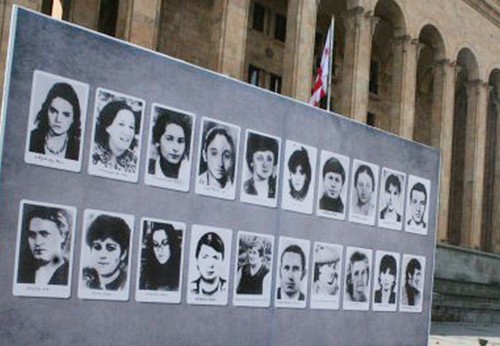
The dispersal of protesters in Tbilisi in April 1989 sharply opposed the society against the country's leadership, the participants in the discussion organized by the Russian Federal Georgian National-Cultural Autonomy (RFGNCA) have noted.
On April 9, 2020, the Tbilisi City Council decided to name six city streets in honour of the women, who perished during the above dispersal.
On April 9, 1989, in Tbilisi, with the participation of the Soviet Army, a peaceful oppositional rally was dispersed. 19 people perished; and several hundred were injured. The tragic events became known as the "Bloody Sunday".
This year marks the 31st anniversary of the tragedy, Andro Ivanov, the press secretary of the RFGNCA has recollected.
The prerequisites for an anti-Soviet rally arose in Abkhazia, Alexander Adamiya, a writer and translator, and a participant in the Tbilisi rally, has reminded.
On March 18, 1989, the residents of the Abkhazian village of Lykhny demanded that they leave Georgia and join the RSFSR (Russian Soviet Federal Socialist Republic), which aggravated the internal political situation in Georgia.
Rallies in Tbilisi in 1989 were the result of a number of prerequisites. In 1978, students took to the streets of Tbilisi and managed to preserve the clause on the state status of the Georgian language in the country's Constitution, Mr Adamiya has noted.
Tensions were growing in the Georgian society. Local residents remembered the events of 1921, the persecutions of the Georgian Church, and suppressions of demonstrations in 1956 and 1978.
After the Tbilisi events, similar actions began taking place in other republics of the USSR.
This article was originally published on the Russian page of 24/7 Internet agency ‘Caucasian Knot’ on April 10, 2020 at 06:49 am MSK. To access the full text of the article, click here.
Source: CK correspondent


![Tumso Abdurakhmanov. Screenshot from video posted by Abu-Saddam Shishani [LIVE] http://www.youtube.com/watch?v=mIR3s7AB0Uw](/system/uploads/article_image/image/0001/18460/main_image_Tumso.jpg "Tumso Abdurakhmanov. Screenshot from video posted by Abu-Saddam Shishani [LIVE] http://www.youtube.com/watch?v=mIR3s7AB0Uw")