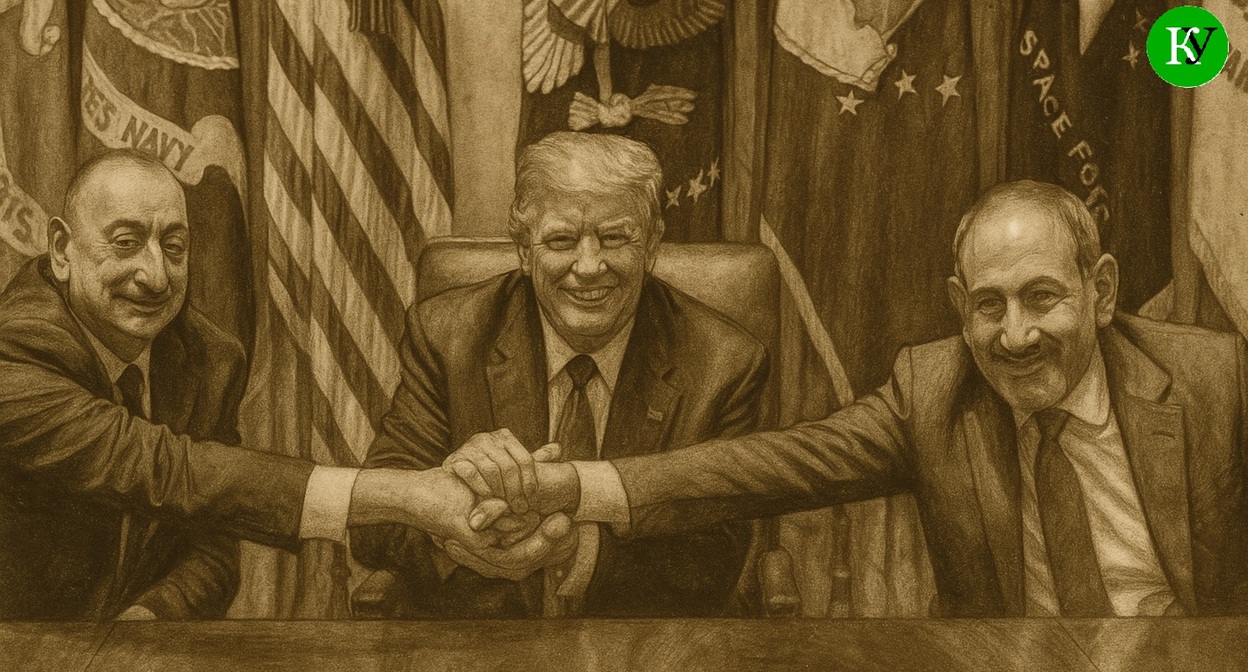


Analysts in Yerevan named the goals of Moscow's pressure on Armenia.
In Russia, it is recognized that Armenia's eurointegration is unlikely in the foreseeable future, but it is used as a pretext for political pressure, Armenian political scientists surveyed by "Caucasian Knot" believe. Among the goals of this pressure, they named the isolation of Yerevan, as well as concessions regarding the nuclear power plant and the railway.
As reported by "Caucasian Knot", Armenian Prime Minister Nikol Pashinyan at a briefing on November 5 called the exit from the EAEU inevitable for joining the European Union. According to him, Armenia plans to submit an application for EU membership in 2027-2028. A few weeks earlier, on October 20, Russia, Belarus, Kazakhstan, and Kyrgyzstan stated that they could temporarily suspend the EAEU treaty concerning Armenia. The joint report of the four countries states that this will restore customs control, and the country's GDP is projected to decrease by 15.6%.
Putin has repeatedly demanded that Armenia decide on participation in the EU or the EAEU, as well as hold a referendum on this issue. The referendum on Armenia's accession to the EU will take place after the corresponding application is submitted and a roadmap is formed, Prime Minister Nikol Pashinyan reported at the end of August. At the beginning of September, when Putin again urged the Armenian Prime Minister to decide as soon as possible on Armenia's accession to the EU, Pashinyan stated that the right moment for this has not yet come.
Armenian Minister of Economy Georgy Papoyan on November 6 called the calculations in the report erroneous, according to which the country's GDP would decrease by 15.6% if the treaty were suspended. According to him, the suspension of Armenia's membership in the EAEU has no legal grounds.
Papoyan told reporters that "if Armenia exits the EAEU, and there are no other influencing factors, economic growth may decrease by 0.65 percentage points." He added that "Armenia's exports to the EU market have increased by 67% this year."
Speaking about the planned discussion in December regarding the possibility of suspending Armenia's membership in the EAEU, the minister stated that "such a step has no legal grounds." He also disagreed with the conclusions of the report prepared by representatives of Russia, Belarus, Kazakhstan, and Kyrgyzstan. It predicts a decrease in Armenia's GDP by 15.6%, or by $4.6 billion, if the EAEU treaty concerning Armenia is suspended. Papoyan called these calculations "erroneous."
"Even with a 300% increase in gas prices, the GDP reduction will not reach 15%," he emphasized.
"Gazprom Armenia," in turn, reported that natural gas supplies from Russia to Armenia are proceeding as usual. Russia supplies gas at a price of $177.50 per thousand cubic meters. The gas price is fixed by an agreement that is valid until the end of 2026 or the beginning of 2027.
Choice without a real prospect
Russia uses Armenia's complicated relations with Turkey and Azerbaijan to isolate Armenia and limit its opportunities for independent foreign policy, believes political scientist Manvel Sargsyan. In his opinion, Moscow realizes that Armenia's European integration is unlikely in the foreseeable future, but uses Yerevan's desire to distance itself from Russia as a pretext for pressure.
"Russia is an empire in a difficult position, and Armenia has decided to gain real sovereignty and effectively sever ties with this empire. Against the backdrop of escalating relations between the West and Russia, Moscow's attitude towards Armenia has changed. There is a fear that Western powers may use states like Armenia against Russia. Official Moscow is satisfied with Armenia making tough statements from time to time and not agreeing with Moscow. This becomes a reason to continue the policy of isolation. Russia uses Armenia's complicated relations with Turkey and Azerbaijan to create additional problems for Armenia," the political scientist told a correspondent of "Caucasian Knot."
"Moscow understands that Europe does not consider Armenia a strategic priority, and its interest in rapprochement with Yerevan is largely driven by the desire to distance Armenia from Russia," Sargsyan said. The European aid allocated, in his estimation, is predominantly symbolic in nature.
The political scientist noted that "Russia benefits from the strengthening of Turkey's influence over Armenia, as Moscow will then be able to address regional issues together with Ankara." He reminded that "historically, Russia and Turkey have often made decisions regarding Armenia without Armenia's participation."
"If you want to build a state, you need to act quietly and calmly. States are built not through talk. You need to create your own opportunities, develop infrastructure, and present others with facts. With great powers, you cannot simply sever ties – you need to conduct a policy such that these ties cease to be decisive within your state," Sargsyan noted.
He also stated that "Europe is not waiting for Armenia, and the question of choice between the EAEU and the EU under current conditions is not a real prospect for Armenia." According to him, Armenia should consistently develop cooperation with European countries and especially with Georgia under such conditions.
"The unity of Armenia and Georgia, the common strategy of these two countries could change the situation throughout the region. It is through Armenia and Georgia that the most important routes to Europe pass, however, Turkey and Azerbaijan seek to present themselves as the main states of the region. We should have understood the value of our own territory, but we have never systematically worked in this direction. The agreement with the USA on the TRIPP project essentially means that Washington took advantage of Armenia's fears and gained control over Meghri – a strategically important part of Armenia, which ultimately deprived Armenia of the ability to influence the development of events in the region," Sargsyan stated.
The report of the EAEU countries as a warning
Political observer Sevak Akopyan noted that "talks about the possible exclusion of Armenia from the Eurasian Economic Union began after the Armenian parliament adopted a law in the spring of 2025 to start the process of Armenia's accession to the European Union."
"During this time, we have not seen any arguments about what benefit this law has brought to Armenia. It seemed that it was adopted intentionally, possibly to demonstrate a certain position to Russia. However, a year and a half after the law was adopted, no real actions towards European integration followed, but Armenia found itself facing the threat of losing its main market. Also, the question of Armenia's status in the EAEU is on the agenda for the organization's summit in December, which suggests that the Russian side has effectively made it clear: where you are going is your business, but we cannot allow you to simultaneously enjoy the economic advantages of the EAEU and move in the opposite direction," the observer told "Caucasian Knot."
The latest statements from the Eurasian Intergovernmental Council indicate that the Russian side is "effectively moving from warnings to concrete actions," he emphasized.
"In fact, Armenia is being told: 'The decision has been made, but we are giving you one last chance.' And as a legal justification, they refer to the EAEU treaty, according to which member states are obliged not to take actions that could jeopardize the achievement of the union's goals, and the Vienna Convention on the Law of Treaties of 1969, which provides for the possibility of suspending the treaty concerning a state that has committed a substantial violation, by mutual agreement of the other participants," Akopyan noted.
The increase in gas prices, in Akopyan's opinion, "will lead to serious economic and social consequences for Armenia."
"The rise in gas prices will increase production costs, reduce enterprise profits, and cut investments. Greenhouse farms, the food industry, the production of building materials, and heavy industry, which consume large volumes of gas, will be particularly vulnerable. Some enterprises may face the threat of closure or job cuts. The rise in gas prices will lead to an increase in prices for essential goods and services. Local products will lose competitiveness in both domestic and foreign markets. If additional costs are passed on to consumers, hundreds of thousands of people will be forced to further limit their spending, choosing between food, education, healthcare, and heating their homes. If the state tries to keep prices down through the budget, this will lead to an increase in external debt, a reduction in spending on infrastructure, education, and social support. Further tightening of tax policy is also not excluded," Akopyan stated.
Gas price among the last levers of pressure
The published report on the possible economic consequences of suspending the EAEU treaty concerning Armenia is a tool of political pressure from Moscow on Yerevan, believes international relations expert David Stepanyan.
In his opinion, Russia's real goals are not so much related to Armenia's European integration as to issues of building a new nuclear power plant and managing the railway system. He noted that discussions about the choice between the EU and the EAEU do not reflect the real situation: the Armenian leadership is currently "not ready to lead the country towards European integration, and Russia understands perfectly well that Armenia is not ready for this process."
"Discussions about the European choice, in my opinion, are used as a pretext for pressure. Moscow cannot openly state that it wants to achieve concessions regarding the construction of the nuclear power plant by 'Rosatom' and the retention of the railway concession under Russian control," Stepanyan told "Caucasian Knot."
At the end of July, Armenian Prime Minister Nikol Pashinyan allowed the possibility of going to court regarding the operation of the South Caucasian Railway (SCR) under concession and stated that Armenia could demand an annual payment from Russia. In response, SCR stated its right to recover investments if the concession changes with Armenia. The arguments of Yerevan that the Russian concession hinders Armenia's participation in logistics initiatives "do not correspond to reality," added the official representative of the Russian Foreign Ministry.
Commenting on the statements of the Armenian authorities about their unwillingness to exit the EAEU, Stepanyan pointed out that "Yerevan does not yet demonstrate intentions to change its format of participation in the union, but there are also no signs of the Armenian side's agreement with Russian demands regarding the nuclear power plant and the railway concession."
The expert did not rule out that Russia could suspend Armenia's membership in the EAEU and raise gas prices, but believes that implementing these steps "would deprive Moscow of its last serious levers of pressure on Yerevan."
"If Russia uses these two instruments, it will no longer have serious levers of influence on Armenia. Military-political levers were lost by Moscow after September 27, 2020, when it allowed Azerbaijan to capture Artsakh (Nagorno-Karabakh) and attack Jermuk. This is unreasonable, and I do not think Moscow will dare to take such actions," Stepanyan noted.
Translated automatically via OpenAI from https://www.kavkaz-uzel.eu/articles/428129