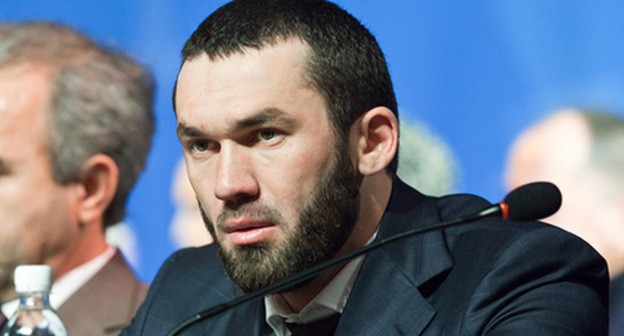


The preliminary hearing in the case of Ali Kerimli was held in closed mode.
The leader of the opposition party of the Azerbaijan Popular Front, Ali Kerimli, accused of attempting a violent seizure of power, stated his intention to refuse participation in the process if the court hearings in his case are closed.
As reported by “Caucasian Knot”, in November 2025, employees of the State Security Service of Azerbaijan detained the leader of the APFP, Ali Kerimli, and his advisor, Mamed Ibrahim. Both opposition figures were arrested and charged under Article 278.1 of the Criminal Code of Azerbaijan (actions aimed at a violent seizure of power or violent change of the constitutional order of the state). They rejected the charges, and Kerimli called his criminal case a political persecution.
On November 3, a preliminary hearing in the case of the leader of the opposition Azerbaijan Popular Front Party (APFP), Ali Kerimli, and party presidium member Mamed Ibrahim took place at the Baku Serious Crimes Court.
“As expected, this political process was conducted in closed mode at the direction of the authorities to hide from the public the disgraceful falsification of the criminal case,” the party's press release sent to the correspondent of “Caucasian Knot” stated.
The lawyers of the accused petitioned for the termination of the criminal case due to the lack of credible evidence of the accused's guilt and for changing their preventive measures; they also requested permission for the accused to sit next to their defenders during the process. None of the defense's petitions were granted.
“Ali Kerimli, in his speech, demanded the termination of the criminal case due to its complete groundlessness. He opposed the closed court for the public. Ali Kerimli warned that if the court continues to be held in closed mode, he will refuse to participate in the process. The next court session is scheduled for November 13,” noted the APFP.
The chairman of the National Council of Democratic Forces (NCDF) Jamil Hasanli called the closed process against Ali Kerimli a violation of the principles of transparency and justice.
“The court session was scheduled for 10:00. I was already near the court by 9:40, but the building was cordoned off by the police. Numerous supporters of the APFP and other citizens who came to the process were not allowed not only into the courtroom but even into the building itself. The police did not let anyone through, stating that the session was being held in closed mode. Meanwhile, the decision on the closed nature of the court proceedings should be made by the judges at the court session itself, but by that time the session had not yet begun. It turns out that the decision on the closed process was made even before the judges began to consider this issue. Obviously, the corresponding order came from above, which in itself indicates the lack of independence of the court,” Hasanli told the correspondent of “Caucasian Knot”.
He pointed out the inadequacy of the charges against Kerimli and Ibrahim, reminding that initially both opposition figures were arrested allegedly for their involvement in a coup prepared by the former head of the presidential administration, Ramiz Mehdiyev.
The Baku Serious Crimes Court sentenced the former head of the presidential administration of Azerbaijan, Ramiz Mehdiyev, to 14 years in prison, but imposed a conditional sentence considering his age and health condition. Mehdiyev is accused of treason, attempting to seize power with the assistance of foreign intelligence services, violently changing the constitutional order, and laundering criminal proceeds amounting to over 17 million manats (10 million dollars).
“The case against Ramiz Mehdiyev was initiated primarily to create a legal and political basis for the persecution of Ali Kerimli: allegedly, the former head of the administration involved the opposition in his coup plan. To hide the absurdity of these claims and their lack of evidence, Mehdiyev's case was separated into a separate proceeding. The trial against Mehdiyev was conducted in a hurry, lasting only 31 days, effectively leaving the content of the charges and the circumstances of the case without broad public attention. Despite the severity of the charges, he received a conditional sentence,” Hasanli pointed out.
Thus, he continued, public attention was diverted from Mehdiyev and focused on Ali Kerimli, whom the authorities label as involved in preparing the coup. In this context, the trial against Mehdiyev appears not so much as an independent judicial proceeding but rather as a preparatory stage of a campaign against the opposition leader, he believes.
The State Security Service of Azerbaijan announced on February 12 that it had uncovered a conspiracy against the authorities involving the former head of the presidential administration, Ramiz Mehdiyev, and the leader of the APFP, Ali Kerimli. According to the SSS, Mehdiyev, Kerimli, APFP member Mamed Ibrahim, and other individuals acted in collusion with the aim of violently seizing power and changing the constitutional order. Mehdiyev's assistant, Eldar Amirov, allegedly participated in the transfer of documents and contacts with foreign entities. The investigation also claims financing and coordination through Azerbaijani diaspora organizations abroad to destabilize the situation in the country, including during the 2013 elections.
“A judicial farce is being played out around events that did not actually occur. This entire story, from the very beginning, judging by its development, was built around the leader of the APFP, state resources have been mobilized against the leader of the opposition party. But still, the version of the accusation is doomed to fail: if Mehdiyev and Kerimli acted together, they should have been giving testimonies and answering questions within the framework of a common judicial process. At the beginning of Mehdiyev's case, pro-government media leaked information that he was allegedly preparing an unconstitutional State Council of 50 members. Where are these 50 people? Why were their names not disclosed to the public? Why were they not held accountable?” Hasanli noted.
He believes that the goal of Mehdiyev's case was to finally deprive him of influence over the state apparatus and confiscate the illegally acquired property. At the same time, Mehdiyev's case was also used to persecute Ali Kerimli, to push the APFP out of the political arena, the politician believes.
At the Baku Serious Crimes Court, “Caucasian Knot” was confirmed that a preliminary hearing in the case of Kerimli took place, but they refrained from commenting on the closed nature of the hearing. Representatives of the prosecution were unavailable for comments.
The persecution of Ali Kerimli has caused international resonance: the European Parliament, PACE, the Canadian-based international human rights organization “Raoul Wallenberg Centre for Human Rights”, representatives of the U.S. Senate, and other organizations have called for the release of the opposition figure.
Translated automatically via OpenAI from https://www.kavkaz-uzel.eu/articles/428045