


Karachai activists called for preserving the memory of the fighters for the rights of victims of political repressions.
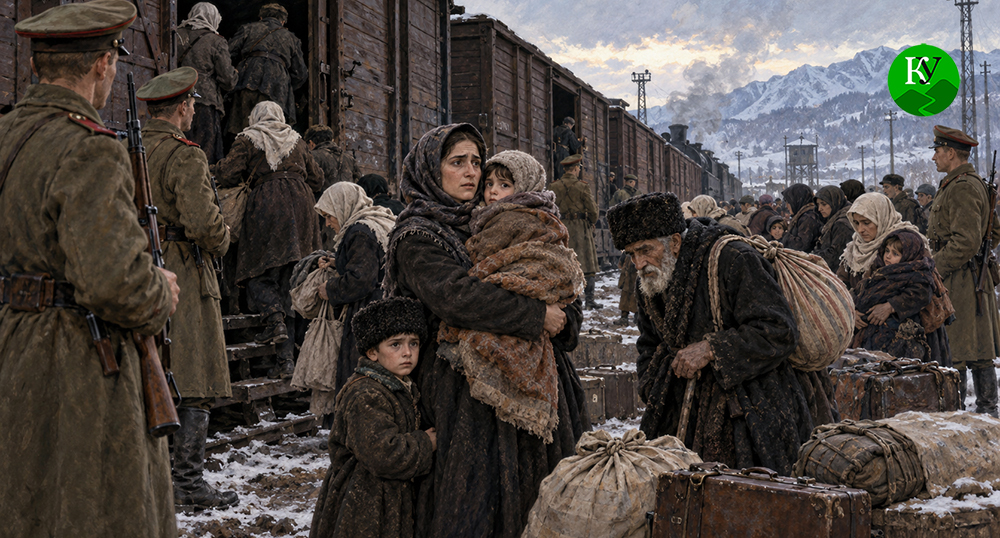
Descendants of deported peoples, including the Karachais, must preserve the historical memory of the repressions, study documents, restore forgotten pages of history, and pass on information about the struggle for the rights of their peoples to future generations, keeping the names of those who defended these rights, urged the Congress of the Karachai people on the 35th anniversary of the adoption of the law "On the Rehabilitation of Victims of Political Repressions."
As reported by "Caucasian Knot", Karachai activists have repeatedly stated that the rehabilitation of the people is incomplete, pointing to insufficient compensation for lost property. In particular, on May 3 of this year, Karachai activists pointed out that the consequences of deportation continue to affect the situation of the people, and the measures for rehabilitation provided by law have not been fully implemented. In November 2025, the chairman of the Congress of the Karachai people, Kady Khalkechev, expressed concern over the initiative to revise the decisions of the XX Congress of the CPSU, which condemned the cult of personality of Stalin. In May of the same year, Karachai activists criticized the silence regarding Stalin's role in the deportation and attempts to portray the Karachais as guilty of the repressions against them.
The deportation of the Karachais began in the USSR on November 2, 1943, resulting in the eviction of 69,267 people (15,980 families). In total, during the pre-war and wartime period, 79,000 people of Karachai nationality were deported. The majority of the repressed - more than 43,000 people, including 22,000 children - died on the way, as well as in resettlement locations. In modern Karachay-Cherkessia, November 2 is considered the Day of the Deportation of the Karachai people. On May 3, 1957, the first families of Karachais returned to their homeland from places of deportation; this day is annually celebrated in Karachay-Cherkessia as the Day of the Revival of the Karachai people, according to the reference material of "Caucasian Knot" "Day of the Revival of the Karachai People: Challenges of Rehabilitation".
Today marks 35 years since the adoption of the law "On the Rehabilitation of Victims of Political Repressions." On April 26, 1991, the Supreme Soviet of the RSFSR adopted the law "On the Rehabilitation of Repressed Peoples." Behind these decisions were the fates of millions of people, the tragedy of deportations, and a long struggle for justice, stated in a statement published today on the page of the Congress of the Karachai people on the social network Instagram*.
We, the descendants of those deported in 1943–1957, must not forget the names of those who fought for our rights.
"We must remember the glorious sons of Karachay who defended the truth and the rights of our people and keep their names in historical memory: Azret Urosov, Abdul Kubanov, Kazi Laipanov, Ismail Aliyev, Kady Khalkechev, Ruslan Semyonov, Ismail Khachirov, Safar Geryukov, Khysa Botashev, Murat Chankaev, Soltan Askakov, Abdullah Tokov, Azret Kecherukov, Dalkhat Kasaev, Kazbek Chomaev, and many other fellow countrymen," the statement said.
Each of the listed public figures deserves respect, the authors of the statement noted. They called for continuing the collection of testimonies, documents, and memories about the activities of public figures to preserve an accurate history of the struggle of the Karachai people for their rights for future generations.
"We, the descendants of those deported in 1943–1957, must not forget the names of those who fought for our rights and dignity," the authors of the statement emphasized.
Preserving historical memory involves studying documents, restoring forgotten pages of history, and passing on accurate information to future generations, the statement said. Its authors called memory a shared responsibility and expressed gratitude to the participants in the struggle for justice.
"The Congress of the Karachai People" is a regional public organization aimed at protecting the rights and interests of the Karachai people, promoting the strengthening of peace and friendship among peoples. Delegates from all over the republic arrive at the organization's congresses.
Karachai activists pointed to the loss of historical and cultural heritage
The deportation of the Karachais led to the destruction of part of the historical and cultural heritage of the people and slowed the development of national science, noted Karachai historian Alan Kara on May 3. According to him, during the years of exile, the study of the history and culture of the Karachais was practically banned or accompanied by falsifications, and after returning to their homeland, the scientific and cultural base had to be rebuilt almost from scratch. "Many objects of material and cultural heritage were destroyed over 14 years," Kara told a correspondent of "Caucasian Knot."
The elder brother of my father died during the deportation. Also, several nieces died of starvation.
The loss of language and national traditions remains one of the most serious consequences of deportation, stated the chairman of the Russian-Turkish Society for Education, Culture, Friendship, and Interaction Muhammad Karachai. In his assessment, a significant part of the youth no longer speaks the Karachai-Balkar language, many traditions have been lost, and the measures taken are insufficient for the full restoration of national culture.
Preserving the memory of the deportation is complicated by the fact that those who survived the exile did not always share their experiences with descendants, noted earlier a resident of Karachay-Cherkessia Amina Botasheva. "Within the family, there was almost no talk about the deportation," she told a correspondent of "Caucasian Knot." According to her, the older generation avoided heavy memories. In the Botashev family, a child's galosh belonging to her grandmother, who survived the eviction, has been preserved: the second girl was lost when the family was sent into exile.
In November 2025, public figure Kady Khalkechev also shared memories of his family's deportation. His father fought at the front, while his mother and other relatives ended up in exile in Kazakhstan. "And the elder brother of my father died during the deportation. Also, several nieces died of starvation," Khalkechev told a correspondent of "Caucasian Knot."
Activists also sought recognition of the merits of Karachais who participated in the Great Patriotic War. In May 2024, Khalkechev reported on unsuccessful appeals regarding the awarding of front-line soldiers. "We petitioned for the title of Hero for 23 participants of the Great Patriotic War. But so far, none of them have been awarded," he noted to a correspondent of "Caucasian Knot."
In May 2023, the Congress of the Karachai people demanded to resume the work of the government commission on the rehabilitation of the Karachai people, whose activities ceased in 2009. According to activists, the commission should also deal with the return of museum exhibits, the restoration of historical geographical names, the publication of works by the Karachai intelligentsia, and the preparation of dictionaries of the Karachai-Balkar language.
The Soviet government justified the deportations of peoples with myths about mass betrayal and desertion by their representatives. Under Stalin, mass arrests, deportations, and executions based on nationality were carried out, according to the reference of "Caucasian Knot" "10 myths about Stalin's role in the Great Patriotic War".
Translated automatically via OpenAI from https://www.kavkaz-uzel.eu/articles/427578
![Tumso Abdurakhmanov. Screenshot from video posted by Abu-Saddam Shishani [LIVE] http://www.youtube.com/watch?v=mIR3s7AB0Uw](/system/uploads/article_image/image/0001/18460/main_image_Tumso.jpg "Tumso Abdurakhmanov. Screenshot from video posted by Abu-Saddam Shishani [LIVE] http://www.youtube.com/watch?v=mIR3s7AB0Uw")