

Commentators criticized the coercion of a Muscovite to apologize on his knees for a conflict with a girl from Chechnya.
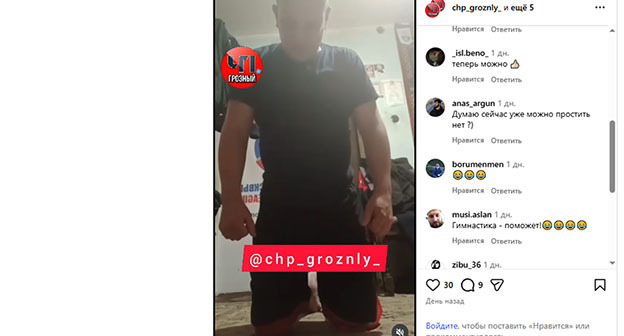
Forcing a passenger of the Moscow metro to apologize on his knees for threats and insults directed at a girl from Chechnya is a humiliation of dignity, and the apologies obtained under pressure do not indicate sincere remorse, users of social media pointed out, demanding a response from the authorities to the incident.
As reported by "Caucasian Knot", on September 26, a video recording of the conflict in the Moscow metro appeared on social media: a man threatened and insulted a girl from Chechnya, and after her words that her compatriots would defend her, he asked the passengers: "Are there any Chechens here?". On the same day, the man recorded the first video with apologies, stating that he did not want to insult the girl, and asked for forgiveness from her, her relatives, and everyone he offended with his words. On September 27, he recorded a new video with repeated apologies, which he delivered while kneeling.
The practice of public apologies initiated by Ramzan Kadyrov has spread beyond Chechnya to other regions of Russia. More about this practice can be read in the "Caucasian Knot" reference "The Fashion for Apologies: From Chechnya to the Outskirts". "Caucasian Knot" also maintains the "Chronicle of Public Apologies in the Caucasus".
Social media users demanded a response from the authorities to the incident involving kneeling apologies
Two posts about the metro passenger's apologies were published on the "Caucasian Knot" Facebook page*, which has about 162,000 followers. As of 13:30 Moscow time on September 28, both publications had a total of 512 comments.
Some commentators found the demand to kneel humiliating and criticized the intervention of outsiders in the conflict. "Two loners collided. The girl, with the mind of a five-year-old, like 'I'm going to tell my brother now,' threw a tantrum. Men with the minds of medieval mercenaries ("I’ll pay half a million," remember?) boldly went into battle against superior enemy forces. Tomorrow this girl will step on someone's foot, and the admiring commentators will also come," wrote Tatiana Tkaceva.
"Just don’t pretend to be decent, we know how you beat your wives, and don’t even think about kneeling before them like this one," wrote Larisa Gomez.
"From Moscow to Kadyrov on your knees, otherwise the king will punish you," sarcastically remarked Lidia Syurtva.
Other users considered the apologies obtained under pressure to be insincere. "Such apologies are worthless if there is no sincere remorse behind them," pointed out Vladimir Platonov.
"Do you think conscience played a role? No, he was scared that they would come for him," believes David Zatiashvili.
"What is in a sober mind is on the tongue of a drunk. What’s the point of apologies?" stated user Alma Aman.
Commentators also called for a response from law enforcement and legal measures instead of extrajudicial pressure. "How is she better than him? In my opinion, they deserve each other... Where is the police and the FSB?" wrote Valery Nazar.
"When a person is drunk, it’s clear that he will behave differently. Let’s not stoke the fire here. Now is such a bad time that everyone lets their tongues loose <…>. We shouldn’t go back to the last century when one tribe attacked another, and the third laughed on the sidelines at how they managed to make others quarrel," called Sveta Sakartvelo.
Some users, on the contrary, approved of the harsh reaction to the insult against the girl.
"Everyone should protect women from such... Respect for women is instilled in Caucasians from childhood, and such vividly expressive behavior as his should be felt on his own skin," wrote Emil Mamedov.
Special reverence for women and mothers is part of the national traditions of Chechens: women have traditionally been seen as the guardians of the home, and there existed a special female space in the house that men tried not to violate, an ethnographer, candidate of historical sciences Saipuddi Nataev, previously told the correspondent of "Caucasian Knot". Publicly displaying another man's woman was not in line with historically established practices in the Caucasus, while a man's honor was associated not with prohibitions and control over women, but with the readiness to protect and support her, the ethnographer, professor Sergey Arutyunov, previously explained to the correspondent of "Caucasian Knot". In the views of some surveyed men in the Caucasus, protecting a woman who is being slandered was contrasted with so-called "honor killings," and the willingness to stand up for a close woman despite public pressure was seen as a manifestation of greater masculinity, sociologist and gender researcher Irina Kosterina previously told the correspondent of "Caucasian Knot".
Statements about Vainakh women have repeatedly become a reason for apologies
Public apologies have previously been prompted by jokes, songs, stories about relationships, and other statements about Chechen and Ingush women. For instance, Alexey Knyazev, a student at the Russian Academy of National Economy and Public Administration, wrote on social media in December 2017 that the relatives' ban on relationships between Caucasian girls and Russian young men contradicts Russian legislation. After that, he began receiving threats, and later the young man was beaten several times and forced to apologize to Muslims and Christians while filming the incident on video.
In April 2024, a visitor to a stand-up concert was forced to apologize before the entire Chechen people, especially the women, after he mentioned during a conversation with a comedian that he had "partied with Chechen girls" during the New Year holidays.
Also, a young man who introduced himself as a skinhead in May 2024 shared in a video posted on social media that he was in love with a Chechen girl. Later, a new video appeared in which he apologized to the Chechen people.
Public apologies have also been made by artists. For example, a rapper performing under the pseudonym Urethra Father recorded a video message in October 2019 apologizing for an obscene song "Chechen Girl." After the publication of the apologies, users of the Chechen public deemed them insufficient, and another performer, Gangwest, publicly denied his involvement in the song and expressed respect for the Chechen people.
Another rapper, Guf (Alexey Dolmatov), apologized in October 2019 after a statement about women of the Caucasus that caused outrage in an interview with Ksenia Sobchak. The performer explained that he used this expression regarding women of different nationalities, but in his apologies, he primarily addressed the Chechens.
Another rapper, Vyacheslav Mashnov, known by the pseudonyms Gnoyny and Slava KPSS, published a video in November 2016 with apologies to Chechen girls for a statement made during a rap battle in 2014. The performer also apologized to girls of other nationalities, calling what he said an unfortunate joke.
Apologies have also come from media companies. For instance, Comedy Club Production and actress Ekaterina Skulkina apologized in December 2017 after the airing of a sketch on Comedy Woman, which social media users perceived as a joke about a girl from Ingushetia working in an escort agency. After the airing of the episode, the participants of the show received threats, including demands to apologize on their knees, and later the TNT stars recorded another video with apologies to the residents of Ingushetia.
Foreigners have also made public apologies. In particular, British videoblogger Benjamin Rich, who visited Chechnya in November 2019, apologized for using the expression "Chechen chick." These words did not refer to a specific girl, but after their spread, some social media users demanded punishment for Rich.
Human rights defenders pointed out the problem of domestic violence in Chechnya
The protection of women in Chechnya from violence by outsiders is combined with threats within the family, as shown by a study of domestic violence in the North Caucasus conducted in 2022-2023. Of the 31 studied sentences in cases of murders of women in Chechnya, in 22 cases, the motive was the murder of women under the pretext of protecting family honor (the so-called "honor killing," – note of "Caucasian Knot"). Accusing a woman of "immoral behavior" can be used as a basis for leniency towards the murderer, noted the president of the Center for Research on Global Issues of Modernity and Regional Problems "Caucasus. World. Development" Saida Sirazhudina. "In Chechnya, such reasons as immorality are voiced because this becomes a basis for leniency," she told the correspondent of "Caucasian Knot."
Women in Chechnya often do not seek help due to family pressure and the desire to maintain the family's reputation, noted Sirazhudina. "Women only seek help as a last resort," she pointed out.
Cultural barriers also hinder victims of domestic violence from turning to law enforcement, emphasized the head of the "Fathers and Daughters" project Aida Mirmaksumova. "So they beat – endure, be silent <...> but you can’t complain to the police," she told the correspondent of "Caucasian Knot."
A woman in Chechnya may remain in the family even in the face of violence due to fear of losing her children, pressure from relatives, and lack of means to protect her rights, noted lawyer Amina Lorsanova. "There is both psychological and physical violence," she told the correspondent of "Caucasian Knot." According to her, cultural barriers have weakened in recent years, women are more often deciding to divorce, and courts and the Sharia committee on family law have sided with women in some cases.
Translated automatically via OpenAI from https://www.kavkaz-uzel.eu/articles/427009

![Tumso Abdurakhmanov. Screenshot from video posted by Abu-Saddam Shishani [LIVE] http://www.youtube.com/watch?v=mIR3s7AB0Uw](/system/uploads/article_image/image/0001/18460/main_image_Tumso.jpg "Tumso Abdurakhmanov. Screenshot from video posted by Abu-Saddam Shishani [LIVE] http://www.youtube.com/watch?v=mIR3s7AB0Uw")