

17 Azerbaijani families returned to Khojavend
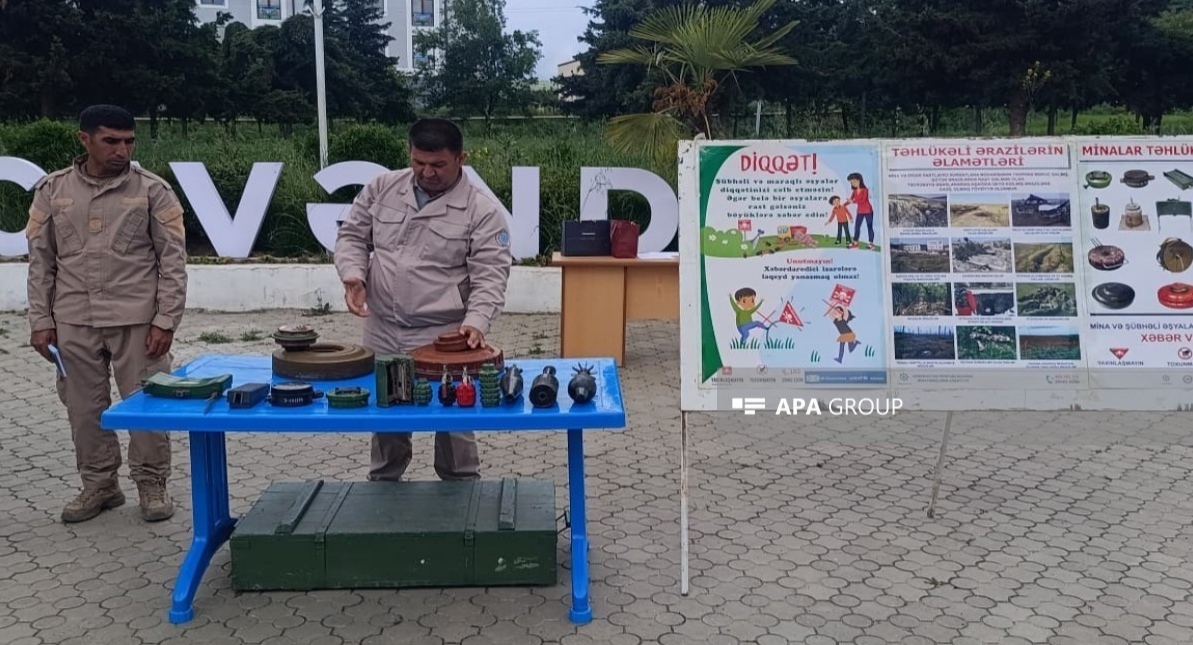
Sixty-five members of Azerbaijani families who fled the city during the Karabakh conflict have returned to Khojavend. They were given keys to their apartments and warned of the danger of mines.
As reported by the "Caucasian Knot," Azerbaijanis from Karabakh settlements were forced to flee their homes after the start of the First Karabakh War. The return of Azerbaijani displaced persons began after Azerbaijan took control of these territories. By March 11, 2026, 7,541 families (30,261 people) had returned to 41 settlements in the former Karabakh conflict zone.
The Khojavend region (the Armenian name for Khojavend is Martuni) had been controlled by the authorities of the unrecognized Nagorno-Karabakh Republic since 1993. On February 20, 2026, the first groups of former internally displaced persons returned to the city of Khojavend and the village of the same name. By April 7, the number of IDPs returned to the city reached 904. On May 8, 57 families (206 people) of former IDPs returned to Khojavend.
On May 22, 17 families (65 people) of former IDPs were resettled to the city of Khojavend. They were given keys to apartments, APA reports.
These families had previously temporarily lived in dormitories, sanatoriums, camps, unfinished buildings, and administrative buildings. In Khojavend, Mine Action Agency employees informed them of the dangers posed by mines and unexploded ordnance, Trend reports.
Internally displaced persons (IDPs) living in a lyceum dormitory in Baku complained about their living conditions. More than 30 families from the Zangelan and Jabrayil districts were housed in the building. The "Caucasian Knot" published a photo report by Aziz Karimov, "Dormitory for IDPs from the Karabakh conflict zone in Baku".
Populated areas have been cleared of mines, but the risk of explosions remains.
In the former Karabakh conflict zone, security forces, sappers, and local residents are periodically killed by mines. From November 2020, when the 44-day war in Karabakh ended, to the end of December 2025, 415 people fell victim to mines and unexploded ordnance in Azerbaijan. Of these, 71 were killed and another 344 were injured.
In November 2023, shortly after the end of hostilities, Azerbaijani authorities announced plans to return 34,500 families (140,000 people) to the former Karabakh conflict zone by the end of 2026. Despite the construction of roads, energy facilities, and housing, the pace of resettlement is constrained by mine danger, lack of jobs, and unresolved land use issues, analysts noted in April 2026.

Villages of Karabakh and Eastern Zangezur, where residents are returning, has been completely cleared of mines, but dangerous zones remain outside populated areas, experts explained.
Mine victims can seek compensation if the incident occurred in an area considered cleared of mines. However, if the incident occurred in an undemined area, entered by the person ignoring warning signs, the state bears no responsibility, said Telman Abilov, head of the Military Lawyers NGO.
Earlier, Azerbaijani residents who returned to Karabakh told the "Caucasian Knot" that they were settling down and finding work. Despite ongoing problems with employment and infrastructure, displaced persons report improved living conditions.
For example, Rashid Aliyev, whose family returned to the village of Khydyrly in the Agdam region in the summer of 2025, reported that his retired parents were provided with a separate two-room house, while he, his wife, and three children were given a three-room house. "Each house was allocated a 12-hectare plot of land. Some planted flowers, others trees. But most, like me, created mini-farms for livestock. I built a barn and a chicken coop. I have four cows, a bull, a dozen rams, two dozen chickens, ducks, geese, and turkeys. The conditions here are excellent for livestock farming," Aliyev said.
On September 19-20, 2023, Azerbaijan launched large-scale military operations and took control of the territory of Nagorno-Karabakh, which began a mass exodus of the Armenian population. By October 7, 2023, 100,632 internally displaced persons from Nagorno-Karabakh had arrived in Armenia, and by September 2024, only 14 Armenians remained in the region. The "Caucasian Knot" has prepared a report "The Beginning and End of the Unrecognized Republic of Artsakh".
Translated automatically via OpenAI from https://www.kavkaz-uzel.eu/articles/423481


![Tumso Abdurakhmanov. Screenshot from video posted by Abu-Saddam Shishani [LIVE] http://www.youtube.com/watch?v=mIR3s7AB0Uw](/system/uploads/article_image/image/0001/18460/main_image_Tumso.jpg "Tumso Abdurakhmanov. Screenshot from video posted by Abu-Saddam Shishani [LIVE] http://www.youtube.com/watch?v=mIR3s7AB0Uw")