

Participants in a rally in Nalchik shared memories of their return from exile.
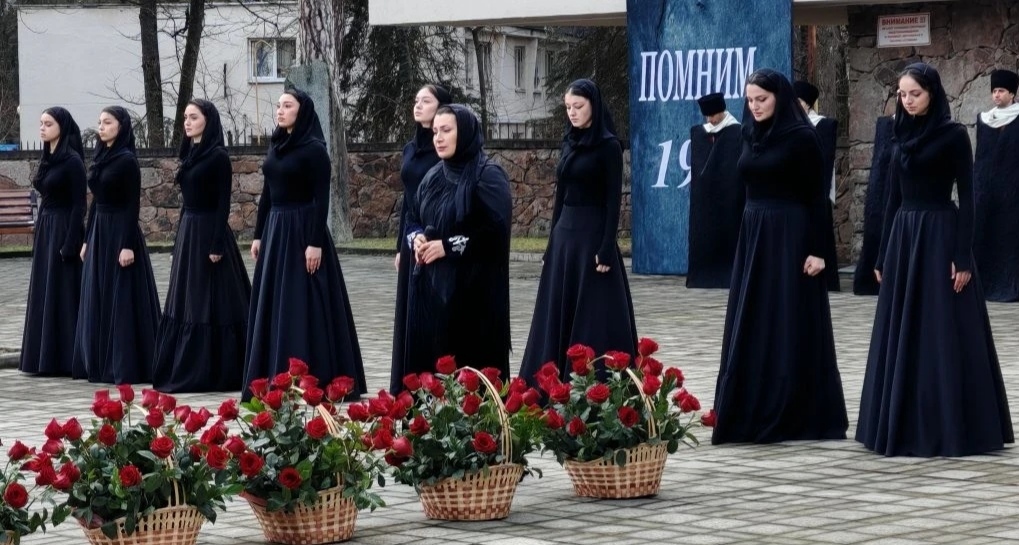
A memorial service was held in Nalchik in memory of the victims of the deportation of the Balkar people, carried out 82 years ago. Participants recalled how their families rushed to return to their homelands when the ban on leaving their places of exile was lifted.
As reported by the "Caucasian Knot," today marks the 82nd anniversary of the deportation of the Balkar people to Kazakhstan and Central Asia. In 2025, a traditional memorial service was held in Nalchik on this day, and in 2024, on the 80th anniversary of the deportation, a renewed exhibition of archival documents and personal belongings of the repressed also opened.
The operation to deport the Balkars took place on March 8, 1944, and lasted only two hours. During this time, war invalids, families of frontline soldiers, and party leaders were deported to Kazakhstan and Central Asia. Of the 37,713 Balkars deported, 52% were children, 30% were women, and 18% were men. During the 18-day journey, 562 people died. Only in 1957 were the Balkars allowed to return to their homeland, according to the "Caucasian Knot" report "Deportation of the Balkars".
Authority representatives attended a traditional rally in Nalchik
Today, a rally dedicated to the 82nd anniversary of the deportation of the Balkar people was held in Nalchik at the "Memorial to the Victims of Political Repression," a "Caucasian Knot" correspondent who attended the event reported.
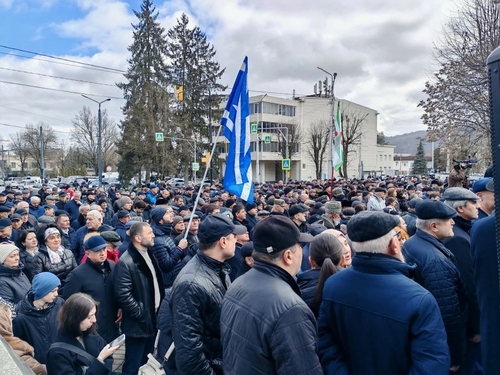 The event began with a literary and musical composition dedicated to the dramatic events, performed by the ensemble "Balkaria", after which the republic's leaders laid flowers at the memorial.
Akhmat Sumayev, head of the public organization "Birlik", Khauti Sokhrokov, president of the International Circassian Association, and Roman Litvinov, head of the Russian History and Culture Society "Veche", spoke at the rally.
The speakers placed the blame for the deportation on the "Stalin-Beria regime", condemned it, and voiced the wish that nothing similar would happen again. happened.
Under Stalin, mass arrests, deportations, and executions based on nationality were carried out; entire nations were declared "hostile," according to the "Caucasian Knot" report "10 Myths About Stalin's Role in the Great Patriotic War." The "Caucasian Knot" also prepared reports on the 1944 deportation of the Chechens and Ingush and the deportation of the Kalmyks. In 1943, the Karachays were also subjected to mass deportation.
Rally participants spoke of their return from exile.
Some rally participants shared their memories with a Caucasian Knot correspondent. For example, Aruzhan Batchayeva reported that she was born in exile.
We arrived, and our house in Khasanye was occupied. Two families lived in it.
"I only know how the deportation took place from what my father and mother told me. But I remember our return well. I was about six years old. We lived in the suburbs of Alma-Ata in the Kazakh SSR. When the decree was issued allowing us to return, we quickly sold all the livestock we had and, without waiting for any trains, boarded a train to Moscow, and from there to Nalchik. We arrived, and our house in Khasanya was occupied. Two families lived in it – Tatars and Russians. The Tatars quickly vacated their half, but we had to argue with the Russians. They vacated our house after their son, who was a serviceman in the Soviet Army, told them so," the elderly woman said.
March 28 marks the day Revival of the Balkar people. It was on this day in 1957 that the decree of the Presidium of the Supreme Soviet of the USSR on the restoration of the Kabardino-Balkarian ASSR was signed.
It was forbidden to leave one's place of residence without permission from the special commandant's office.
The family of Mukhadin Uzdenov was exiled to the Taldykorgan region of the Kazakh SSR. "My parents worked on a sugar beet farm. Besides the Balkars, there were also repressed Chechens, Ingush, and Crimean Tatars living there. The exiles weren't allowed to leave their homes without permission from the special commandant's office. Only on Sundays were they allowed to go to the market. The market was a meeting place for all the exiles. Here they met, socialized, and exchanged news. The exiles grew closer, adopting the agricultural practices of neighboring peoples, which allowed them to achieve high vegetable yields," he said.
According to the man, when the decree on the rehabilitation of repressed peoples was issued, the Uzdenov family, like the other exiles, greeted it with jubilation.
"The restrictions on the Balkars were lifted on April 18, 1956, but the right to return to their homeland was not yet granted. Nevertheless, many Balkars, including my family, returned to their homeland. "The Balkars began to be returned to their former places of residence in an organized manner in 1957-1958," Uzdenov said.
Aishat Sultanova admitted that she doesn't celebrate International Women's Day as a holiday. "For me, this holiday is ruined forever. I don't celebrate it – I don't accept congratulations and I don't congratulate anyone. I don't think there's any need to explain why," said a participant in the memorial rally.
A family member of repressed people had to prove his right to payments in court
The rally participants also reported that repressed people who were deported as children or born in exile receive a pension supplement of 800 rubles. However, not everyone is granted this bonus by default.
For example, Magomed Tolgurov, a resident of the village of Bylym in the Elbrus District, had to prove in court that he was eligible for repression. Magomed Tolgurov was born on June 6, 1956 – 12 days after his parents, who had been exiled to the Kirghiz SSR, were removed from the register as special settlers upon their return to their homeland.
On this basis, the Information Center of the republic's Ministry of Internal Affairs refused to issue him the necessary certificate. Tolgurov then filed an administrative claim with the Nalchik City Court. He requested that the Ministry of Internal Affairs' refusal be declared illegal and overturned, and that the agency be ordered to issue him a rehabilitation certificate.
The court upheld Tolgurov's claim. As justification, the court cited the fact that after returning to their homeland, rehabilitated Balkars were not allowed to return to their former places of residence for at least another year, until 1957, said Magomed Tolgurov.
Magomed Tolgurov was rehabilitated on December 19, 1994, and the Nalchik City Court issued its decision on his claim on October 10, 2024. In its appeal, the Ministry of Internal Affairs requested that this decision be overturned, but the Supreme Court of Kabardino-Balkaria upheld it on January 31, 2025, according to the appellate court's website.

Recall that the consequences of the deportation still affect the lives of the Balkars, and rehabilitation cannot be considered complete, activists interviewed by the "Caucasian Knot" stated in 2024. In their opinion, the number of informal events marking the anniversary of the deportation has decreased in recent years, with people preferring to remember the dead within the family circle.
Natives of the Caucasus took an active part in the Great Patriotic War, and myths about their mass desertion and collaboration are based on data intended to justify the repressions against Caucasian peoples, historians Alexei Bezugolny, Nikolai Bugai, and Evgeny Krinko stated in 2015.
The decision on which peoples to repress depended directly on Stalin, historian and member of the Association of Russian Society Researchers Boris Sokolov told the Caucasian Knot in 2022.
Translated automatically via OpenAI from https://www.kavkaz-uzel.eu/articles/421432

![Tumso Abdurakhmanov. Screenshot from video posted by Abu-Saddam Shishani [LIVE] http://www.youtube.com/watch?v=mIR3s7AB0Uw](/system/uploads/article_image/image/0001/18460/main_image_Tumso.jpg "Tumso Abdurakhmanov. Screenshot from video posted by Abu-Saddam Shishani [LIVE] http://www.youtube.com/watch?v=mIR3s7AB0Uw")