

Volunteers removed nets from the destroyed ramparts on the Bugayskaya Spit before the storm.
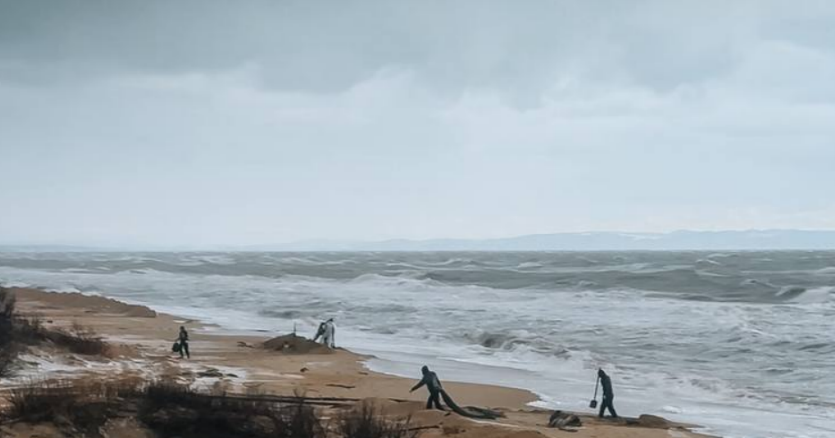
The "Net, Sieve, Shovel" headquarters cleared nets torn from protective embankments by strong waves. Volunteers explained that they tried to remove the nets before the storm to prevent them from being washed into the sea, but lamented their inability to preemptively remove the nets as the storm approached.
As reported by "Caucasian Knot," scientists and Kuban authorities acknowledged that the environmental consequences of the fuel oil spill in the Kerch Strait have not been eliminated even a year after the tanker accident. The government commission coordinating the cleanup of the fuel oil spill in the Kerch Strait reported that more than 90% of the spilled oil product has been collected. An Emergency Ministry spokesperson reported that all three cofferdams had been installed, and 29.6 kilometers of protective embankments had been constructed along the coast to protect the beaches. On January 1, following a severe storm, bloggers reported new oil spills and partial destruction of protective embankments. After the storm, protective nets were scattered along the coast in Anapa and the Temryuk district; in some places, they were covered with sand, and in others, they were at the water's edge and could be carried out to sea, bloggers reported.
Volunteers from the "Nets, Sieve, Shovel" headquarters reported on January 2 that they had spent the entire day clearing nets from protective embankments destroyed by the storm. "
"The embankment on the spit will certainly be washed away by the approaching storm. "The previous volunteers have already partially completed the task, scattering and burying the nets in the sand along the way. Our task is simple: to prevent the nets from floating away from the remaining embankment into the unknown and to dig up what is already buried in the sand and what will be," they wrote on their Telegram channel.
"Unfortunately, we don't have the right to simply remove all of this in advance. Although that would have saved us from unnecessary problems," they stated.
According to them, the number of volunteers has increased thanks to a group who came from Moscow. "We pulled a huge span of net out of the sand, about 100 meters opposite the barrier. Then we moved to the right to the next section, where the embankment had already washed away and the nets were covered in sand. It started hailing... but we still managed to dig up some of them. We are leaving the nets that are blown away in the moment." "We can't," the volunteers wrote.
We've updated our apps for Android and IOS! We appreciate criticism and development ideas both in Google Play/App Store and on KU's social media pages. You can read our content without installing a VPN. in Telegram (in Dagestan, Chechnya and Ingushetia - with VPN). Through VPN, you can continue reading the "Caucasian Knot" on the website as usual, and on social networks Facebook*, Instagram*, "VKontakte", "Odnoklassniki" and X. You can watch the "Caucasian Knot" video on YouTube. Send messages on WhatsApp* to +49 157 72317856, on Telegram to the same number, or write to @Caucasian_Knot.
* Meta (owner of Facebook, Instagram, and WhatsApp) is banned in Russia.
Translated automatically via OpenAI from https://www.kavkaz-uzel.eu/articles/419621

![Tumso Abdurakhmanov. Screenshot from video posted by Abu-Saddam Shishani [LIVE] http://www.youtube.com/watch?v=mIR3s7AB0Uw](/system/uploads/article_image/image/0001/18460/main_image_Tumso.jpg "Tumso Abdurakhmanov. Screenshot from video posted by Abu-Saddam Shishani [LIVE] http://www.youtube.com/watch?v=mIR3s7AB0Uw")