

Karabakh leaders denied the accusations in their final statements
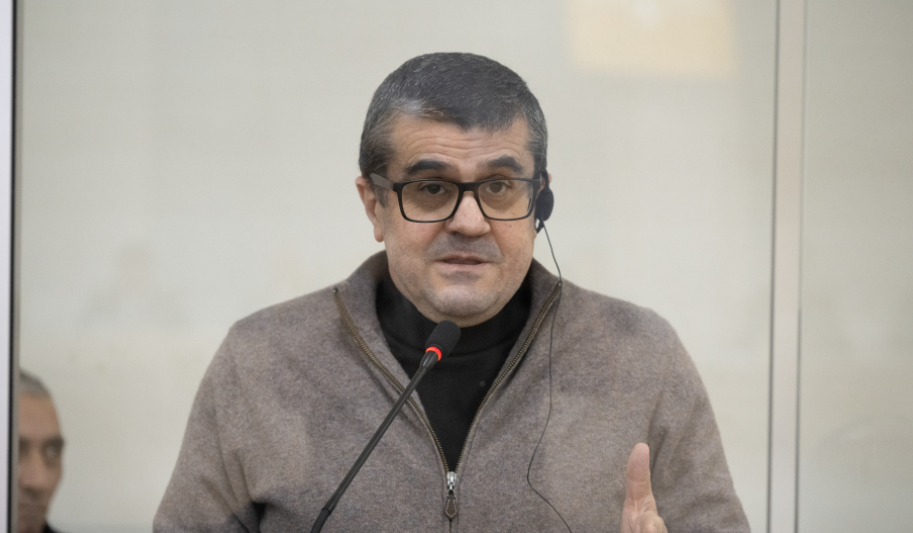
Former Nagorno-Karabakh President Arayik Harutyunyan stated that he heard about a number of war crimes he is accused of for the first time in the courtroom and refused to admit guilt. Two other defendants expressed a similar position. Ruben Vardanyan's international lawyer, commenting on the requested life sentence, called the charges fabricated. 1
As reported by "Caucasian Knot," the trial of the former Nagorno-Karabakh leaders accused of war crimes concluded on October 31. The prosecution requested life imprisonment for Arayik Harutyunyan, David Ishkhanyan, David Babayan, Levon Mnatsakanyan, and David Manukyan, and 16 to 20 years in prison for the others. On December 4, the lawyers of their clients called the guilt of their clients unproven and called on the court to acquit them. On December 11, eight defendants in the case against the military-political leadership of Nagorno-Karabakh made their final statements before the court in Baku. All of them stated that they do not consider themselves guilty of the war crimes charged against them.
The defendants are 15 former Karabakh officials, including Presidents Arayik Harutyunyan, Bako Sahakyan, and Arkady Ghukasyan, as well as Parliament Speaker David Ishkhanyan. The case of Nagorno-Karabakh State Minister Ruben Vardanyan is being heard separately. They are charged under more than 20 articles, and the case contains 2,548 counts. The "Caucasian Knot" has prepared a report titled "Vardanyan and 15 Karabakh leaders: key points about the Baku courts".
Today, the Baku Military Court continued hearing the defendants' final statements. David Manukyan continued his testimony. He stated that he disagreed with the prosecutors' arguments, emphasizing that he was not present at the regime's "security council meetings" either as a participant or as an observer—his official duties did not allow him to do so, Azertac reports.
In his closing statement, Arayik Harutyunyan stated that he disagreed with the prosecutors' arguments defending the state prosecution. In his speech, Harutyunyan said that he and his two brothers attended school in Karabakh and that they had no problems receiving an Armenian-language education. He also said there were no problems between them and the Azerbaijanis, adding, "We attended each other's events."
In his final statement at the court hearing, the defendant also spoke about the war crimes he is accused of. "War crimes were presented here." "To be honest, I learned about most of them for the first time," he noted.
He listed the charges brought against him (joining a criminal organization, conducting illegal business activities, destruction, mercenaries, planting mines, obstructing air traffic, murder, violence, rocket attack on Ganja, etc.) and stated that he did not accept the charges.
Defendant David Babayan spoke in Russian and also voiced his counterarguments to the prosecution's position and the arguments of the victims.
The trial will continue on December 22.
The defendants are charged under Articles 100 (planning, preparing, unleashing, or waging an aggressive war), 102 (attack on persons or institutions enjoying international protection), 103 (genocide), 105 (destruction of the population), 106 (slavery), 107 (deportation or forced displacement of population), 109 (persecution), 110 (enforced disappearance of persons), 112 (deprivation of liberty in violation of international law), 113 (use of torture), 114 (mercenarism), 115 (violation of the laws or customs of war), 116 (violation of international humanitarian law during armed conflicts), 118 (war robbery), 120 (premeditated murder), 192 (illegal business), 214 (terrorism), 214-1 (financing of terrorism), 218 (organization of a criminal community (criminal organization), 228 (illegal acquisition, transfer, sale, storage, transportation or carrying of weapons, components therefor, ammunition, explosives and explosive devices), 270-1 (acts that create a threat to aviation security), 277 (attempt on the life of a statesman or public figure), 278 (violent seizure of power or violent retention of power, violent change of the constitutional order of the state), 279 (creation of armed formations or groups not provided for by law) and other articles of the Criminal Code of the Republic of Azerbaijan, the publication says.
Vardanyan's international lawyer called the charges fabricated
At a hearing in the Baku Military Court on December 18, the prosecutor proposed sentencing former Nagorno-Karabakh State Minister Ruben Vardanyan to life imprisonment. The process does not meet the requirements of a fair trial, Vardanyan said.
At a hearing in the case of former Nagorno-Karabakh State Secretary Ruben Vardanyan on December 18, the prosecution announced the charges brought against him. They stated, "Vardanyan, by engaging in criminal community" on the territory of Karabakh, "was aware of the public danger of his actions." He stated that a number of districts and villages of Azerbaijan came under the control of Armenia and the criminal community from 1988 to 1994. "Private property was damaged through destruction, arson, looting and other means, and people were forced to leave their homes," the prosecutor noted, stating that the results of the inspection of Vardanyan's office in Khankendi and documents confirm "that the accused joined the criminal community in early December 2020," the Report agency reported on the same day.
The prosecutor stated Vardanyan's connections with Vladimir Vartanov, the founder of the VoMa organization, which took part in military operations against the Armed Forces of the Republic of Azerbaijan, as well as their negotiations via messenger. In particular, according to the prosecution, issues of training militants and instructors, organizing training sessions, as well as committing terrorist acts against the Armed Forces of the Republic of Azerbaijan and the participation in the hostilities of the remnants of the Armenian army and illegal Armenian armed formations." According to the prosecution, Vardanyan was involved in financing the organization.
The prosecutor reported that the next charge brought against Vardanyan is related to the illegal crossing of the state border of Azerbaijan in September 2022, when he, as a foreign citizen, illegally crossed the protected state border of the Republic of Azerbaijan outside the checkpoints established by the state - from the territory of the Republic of Armenia in the direction of the Lachin region - and entered the territory of Azerbaijan, where he subsequently settled. Also, after this, he "left the territory of the country several times, traveling to various countries, and then illegally returned to the territory of the Republic of Azerbaijan."
The prosecution alleges that Vardanyan financed mining work and the organization of military warehouses in the vicinity of Khankendi. According to the prosecution, Vardanyan was engaged in the purchase of unmanned aerial vehicles (UAVs) of the Malloy type with a carrying capacity of 180 kg and flight range of 70 km.
Vardanyan faces the following charges: planning, preparing, unleashing and waging an aggressive war, attacking internationally protected persons and illegally crossing the state border of the Republic of Azerbaijan, forced displacement of population, persecution, enforced disappearance of people, deprivation of liberty in violation of international law, torture, mercenary activity, violation of the laws and customs of war, violation of international humanitarian law during an armed conflict, premeditated murder, illegal entrepreneurship, terrorism, financing of terrorism, creation of a criminal association (organization), illegal acquisition, transfer, sale, storage, transportation and carrying of weapons, their components, ammunition, explosives and devices, actions threatening aviation safety, violent seizure of power and forcible retention of it, violent change of the constitutional structure of the state, creation of armed formations and groups not provided for by law, the publication says.
Ruben, like other Armenian Christian prisoners, is in prison simply for defending the right of the people of Nagorno-Karabakh to self-determination
Ruben Vardanyan's international lawyer Jared Genser called the prosecution's position on his page on the social network X "a horrific, but unfortunately predictable turn." "At another closed session, state prosecutors completed the presentation of their "position" and demanded that Ruben be sentenced to life imprisonment on the basis of dozens of fabricated charges. The truth is that Ruben, like other Armenian Christian prisoners, is in prison simply for defending the right of the people of Nagorno-Karabakh to self-determination," he wrote.
As a reminder, the Baku Military Court has been hearing Vardanyan's case since January 2025. Vardanyan's case is being heard separately from the cases of the other Karabakh The charges brought against Vardanyan, including war crimes, terrorism, and terrorist financing, carry a sentence of up to life imprisonment. Since April 1, victims have been speaking at the hearings. The defendant and his lawyer have repeatedly filed protests to the court, but all motions to recuse the judges have been denied.
Translated automatically via OpenAI from https://www.kavkaz-uzel.eu/articles/419243
![Tumso Abdurakhmanov. Screenshot from video posted by Abu-Saddam Shishani [LIVE] http://www.youtube.com/watch?v=mIR3s7AB0Uw](/system/uploads/article_image/image/0001/18460/main_image_Tumso.jpg "Tumso Abdurakhmanov. Screenshot from video posted by Abu-Saddam Shishani [LIVE] http://www.youtube.com/watch?v=mIR3s7AB0Uw")