

Putin ignored questions from residents of southern Russia during his direct line-up.
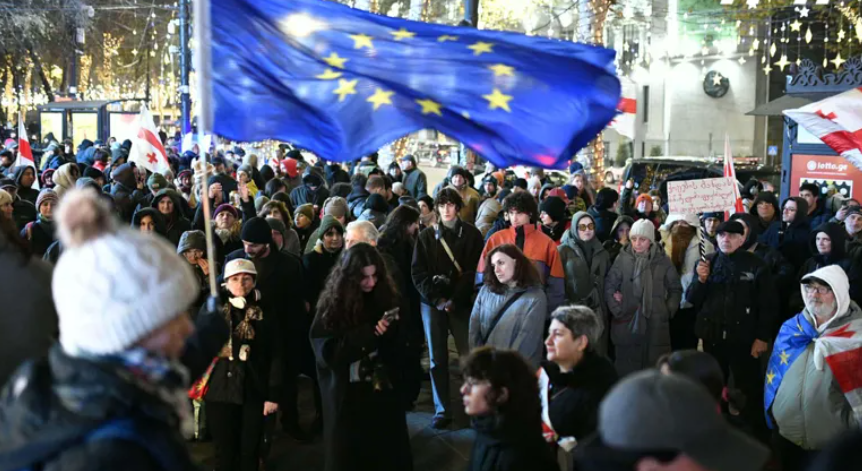
Residents of southern Russia hoped that their questions, voiced during the direct line with the president, would lead to solutions to pressing problems, but their requests were never aired. Specifically, questions about the opening of Anapa's beaches and a request from residents of the Yubileiny microdistrict in Krasnodar, which had been recorded by about a thousand people, were not aired.
As reported by the "Caucasian Knot," residents of southern Russia, in the lead-up to the direct line with Putin, asked for help in resolving environmental, transportation, and utility issues. At least five collective requests were addressed to Putin from the Krasnodar Territory.
Before the direct line began, its hosts drew attention to a poster held by a journalist present. "'Astrakhan' is written on a figurine depicting a Caspian roach. We have a question about the development of the North-South international transport corridor and the problem of the shallowing of the Volga, which affects not only people but also nature, particularly aquatic bioresources," noted the person holding the sign. However, the question was never aired.
A total of over 3 million questions were received during the direct line. The direct line lasted 4.27 minutes, according to Vesti State Television and Radio Broadcasting Company.
"That's it. They didn't mention Anapa," blogger Max Anapsky concluded after the direct line. "A very bad sign, meaning they can't say anything about the prospects. Anapa isn't in the center of federal attention. Or regional attention either," he wrote in another message on his Telegram channel, which had garnered 22 comments by 5:40 p.m. Moscow time.
"There was no question about Anapa, so there's no answer. And all we can do is prepare for the worst, while not losing hope for the best," wrote user Mia Mia.
"Who needs Anapa? It's more important to know who the president likes and the license plate number of his car," quipped Dmitry Safronov.
On December 12, Kuban blogger Yuri Ozarovsky recorded a video message for a direct line with Putin asking for permission to open Anapa's beaches in 2026. Following the fuel oil spill in the Kerch Strait, Rospotrebnadzor (the Federal Service for Surveillance on Consumer Rights Protection and Human Wellbeing) declared 141 beaches in Anapa and nine beaches in the Temryuk District unsuitable for recreation. By the end of the summer season, tourist traffic to Anapa had fallen by approximately 60%. Due to a record drop in revenue, Anapa's sanatoriums and children's camps are teetering on the brink of closure.
"Not a single question was raised about the environment. Although the term was mentioned. And the word #mazut was mentioned, but... We hope the questions submitted won't be forgotten," noted the public group "Ecodefense KMV," which has over a thousand subscribers.
The authors of one petition from Novorossiysk asked for a solution to the problem of regular fires at the landfill, which are causing people to suffer from smoke. "For the past 3-4 years, fires have been breaking out at the landfill, and they haven't been extinguished for a long time. The fires produce acrid smoke that billows across residential areas. It's difficult to breathe not only in the streets but also in homes. Over the entire period, residents have repeatedly appealed to various authorities, but to no avail," Novorossiysk residents complained on December 15.
"No statements were made on air from the Krasnodar Territory, but we know the main issues that concern our residents, and we will work on them," Krasnodar Territory Governor Veniamin Kondratyev promised on his Telegram channel.
Residents of Kuban are most often interested in pensions, transportation infrastructure, and family and children. Vladimir Putin also received questions from Krasnodar Krai on his direct line regarding access to healthcare and land issues. Krasnodar TV channel also addressed issues of concern to residents of Kuban, citing infographics during the broadcast.
Ahead of the direct line with Vladimir Putin, residents of Krasnodar's Yubileyny microdistrict, protesting against embankment development, recorded a video message to the president. According to City Duma deputy Alexander Safronov, more than 1,000 people participated in the protest. On December 17, Safronov was summoned to the police station for a video message to Putin.
The Volgograd Region led the way in the number of calls to the direct line with Russian President Vladimir Putin complaining about the shortage of subsidized medications: this data was provided by the broadcast's organizers after one of the participants raised the issue of the need to buy vital medications out of pocket, V1 reports.
"Before the broadcast, I spoke with the government officials responsible for this. They assured me that all federal responsibility for the compulsory medical insurance system has been transferred to the regions." "There is not a single boring delay," the publication quotes the president as saying.
The Direct Line outraged journalist Ksenia Sobchak "The questions from colleagues on the Direct Line are very strange. Endless greetings, invitations to visit the region, to visit. Every second person asks three questions, proposes marriage live on air. And this turns a cool format into some kind of entertainment. Very unprofessional behavior and a lack of important and truly pressing questions," she noted on her Telegram channel.
We have updated the apps on Android and IOS! We would be grateful for criticism and ideas for development both in Google Play/App Store and on KU pages in social networks. Without installing a VPN, you can read us on Telegram (in Dagestan, Chechnya and Ingushetia - with VPN). Using a VPN, you can continue reading "Caucasian Knot" on the website as usual, and on social networks: Facebook*, Instagram*, "VKontakte", "Odnoklassniki" and X. You can watch the "Caucasian Knot" video on YouTube. Send messages to +49 157 72317856 on WhatsApp*, to the same number on Telegram, or write to @Caucasian_Knot.
* Meta (owner of Facebook, Instagram, and WhatsApp) is banned in Russia.
Translated automatically via OpenAI from https://www.kavkaz-uzel.eu/articles/419234

![Tumso Abdurakhmanov. Screenshot from video posted by Abu-Saddam Shishani [LIVE] http://www.youtube.com/watch?v=mIR3s7AB0Uw](/system/uploads/article_image/image/0001/18460/main_image_Tumso.jpg "Tumso Abdurakhmanov. Screenshot from video posted by Abu-Saddam Shishani [LIVE] http://www.youtube.com/watch?v=mIR3s7AB0Uw")