

Religious scholars and human rights activists have identified ways to resolve conflicts over prayer at an Ossetian university.
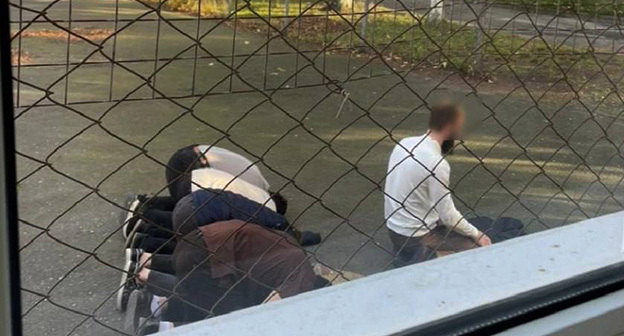
University administration can provide students with a prayer room, but it is impossible to expel a student for public prayer, the lawyer pointed out. The timing of prayer in Islam is flexible, Islamic scholars noted, commenting on the resonance at the North Ossetian Medical Academy.
As "Caucasian Knot" reported, the publication of photographs of public prayer by students of the North Ossetian Medical Academy in Telegram channels caused controversy about the permissibility of public prayer and the students' need for a special room. The ethnic composition of the university has changed, including due to the large number of students from India and Chechnya, the North Ossetian ombudsman pointed out, calling on the university administration to carry out preventive work. The rector of the North Ossetian Medical Academy considered publications about students' namaz incitement of interethnic hatred, noting that religious sentiments do not influence the training of future doctors, and that outside of class time, students "are not limited in their freedom of religion."
A Muslim's orthodoxy is not determined by literal observance of namaz times down to the minute, noted Islamic scholar Leonid Syukiyainen.
"In Islam, there are five obligatory daily prayers, but Sharia law allows for flexibility in their performance. If a prayer falls during study or work time, it can be rescheduled within the permitted timeframe. For example, the afternoon prayer can be performed immediately after classes, if its time has not yet expired. Islam also permits the combination of certain prayers. A Muslim's piety isn't determined by precise adherence to prayer times; intention and observance within acceptable limits are more important. "Interrupting studies for prayer is not a mandatory requirement for a Muslim," he told the Caucasian Knot.
According to him, Islam requires a clean place and minimal privacy for prayer, but not necessarily a mosque. "Praying on a sports field or in a university hallway is formally permissible if the place is clean, but it's more appropriate to find a secluded place or use specially designated rooms, showing respect for local culture and avoiding conflict. I don't know about North Ossetia, but this option is available at universities in Muslim regions. I haven't seen it in other regions," he said.
The Moscow religious scholar also notes that prayer rooms are only available at universities in Muslim regions. "In Chechnya, Ingushetia, Dagestan, and other regions, they are available, but not in the rest." It's important to understand that Russia is a secular state, and universities generally discourage the creation of prayer rooms, whether for Muslims or Buddhists. Regarding North Ossetia, students should understand that namaz must be performed in a way that doesn't trigger or irritate anyone. For example, a sports field is also university property, and if the administration objects, then they should seek out secluded areas or perform it elsewhere," he told the Caucasian Knot.
According to him, if namaz falls during class time, students have every right to delay their prayer. "There is no obligatory rule in Islam that prescribes namaz at a specific time, and it's not considered a sin to not perform it at that time. On the contrary, Islam allows for delaying namaz times and performing it after classes or work, for example. If studying interferes with someone and they miss classes and lectures to perform namaz, then in that case, they shouldn't enroll in a university. "Russia is a secular state, and our Muslims aren't always well-versed in the law. If it's not permitted, then we need to find other ways, rather than performing namaz despite prohibitions," he emphasized.
Performing namaz on the street is not a violation of the law, notes lawyer Yevgeny Smirnov. "Prayer on the street itself is not an offense; the Constitution guarantees freedom of religion. Problems arise if it's a public event with more than one person participating without notifying the authorities. Prayer in a group of 5-10 or more people can be considered a public event. In this case, liability under Article 20.2 of the Code of Administrative Offenses of the Russian Federation (a fine of 10-20 thousand rubles) is possible. And performing namaz itself is not missionary work unless there is active campaigning and calls for others to join," he told the "Caucasian Knot."
Threats of expulsion for namaz, if carried out, could be considered discrimination, the lawyer noted. "Expelling someone for namaz alone is impossible; that would be a violation of the right to freedom of conscience and discrimination. The Federal Law "On Education" provides for expulsion for violating the charter, but the university must first issue a warning or reprimand, and only then expulsion. Any expulsion for namaz will be challenged in court as discrimination. The university can legally prohibit public religious practices in classrooms and require the use of special prayer rooms," he noted.
Banning namaz will not prevent conflicts, believes Svetlana Gannushkina, head of the Civic Assistance Committee*. "If students need collective prayer, they can be provided with a room for this time. I believe that banning collective prayer is not appropriate; bans will not prevent conflicts. "And namaz can't be called missionary work, especially since there are no such court cases," she told the "Caucasian Knot."
In her opinion, universities should have prayer rooms. "I don't know if universities have model rooms, but prisons do. And where they ban model rugs and Korans from being taken into solitary confinement, trouble begins. I once had to go to the prison colony and discuss the situation with the administration. At the time, I was able to do this because I was a member of the Human Rights Council, not a 'foreign agent.'" "We managed to resolve the conflict," she said.
We've updated our apps for Android and IOS! We welcome criticism and development ideas both in Google Play/App Store and on KU's social media pages. Without installing a VPN, you can read us on Telegram (in Dagestan, Chechnya, and Ingushetia, with a VPN). Using a VPN, you can continue reading "Caucasian Knot" on the website as usual, and on social networks: Facebook**, Instagram**, "VKontakte", "Odnoklassniki" and X. You can watch the "Caucasian Knot" video on YouTube. Send messages to +49 157 72317856 on WhatsApp**, to the same number on Telegram, or write to @Caucasian_Knot.
* are listed as foreign agents.
** Meta (owner of Facebook, Instagram, and WhatsApp) is banned in Russia.
Translated automatically via OpenAI from https://www.kavkaz-uzel.eu/articles/417701


![Tumso Abdurakhmanov. Screenshot from video posted by Abu-Saddam Shishani [LIVE] http://www.youtube.com/watch?v=mIR3s7AB0Uw](/system/uploads/article_image/image/0001/18460/main_image_Tumso.jpg "Tumso Abdurakhmanov. Screenshot from video posted by Abu-Saddam Shishani [LIVE] http://www.youtube.com/watch?v=mIR3s7AB0Uw")