

The trial of Karabakh leaders in Baku has become a historical precedent.
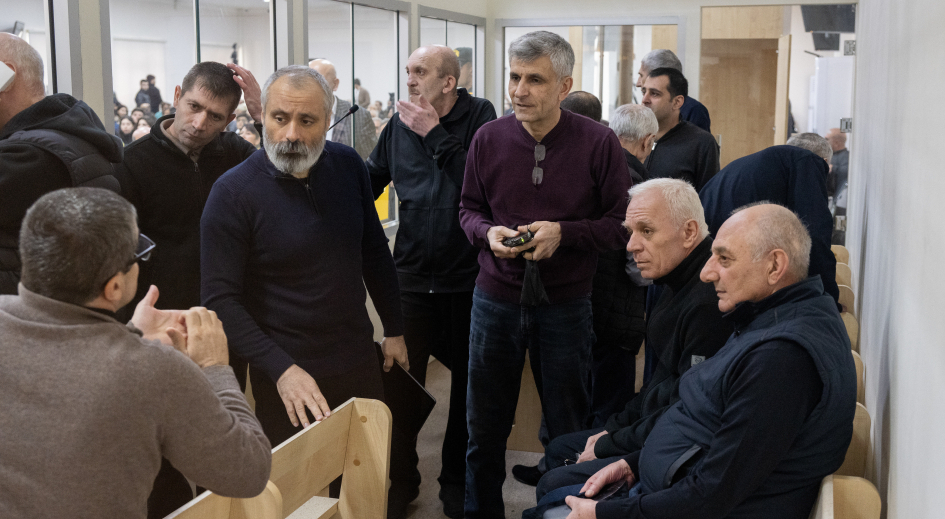
The trial of former Nagorno-Karabakh leaders in Baku has unique features; there have been no similar trials in world history. International trust in this court has been undermined, but the process is largely designed for a domestic audience, analysts interviewed by the "Caucasian Knot" noted.
As "Caucasian Knot" reported, the trial of the former leaders of the unrecognized republic of Nagorno-Karabakh, accused of war crimes, concluded on October 31. The prosecution requested life imprisonment for Arayik Harutyunyan, David Ishkhanyan, David Babayan, Levon Mnatsakanyan, and David Manukyan, and 16 to 20 years in prison for the others. The lengthy indictment was prepared in advance, lawyer Siranush Sahakyan is sure.
Fifteen former Karabakh officials are on trial, including former presidents Arayik Harutyunyan, Bako Sahakyan and Arkady Ghukasyan, as well as former parliament speaker David Ishkhanyan and former state minister of Nagorno-Karabakh Ruben Vardanyan, the latter's case being heard separately. They have been charged under more than 20 articles, and the case contains 2,548 counts. The "Caucasian Knot" has prepared a report entitled "Vardanyan and 15 Karabakh leaders: key points about the trials in Baku".
Aleksey Gunya, a senior researcher at the Institute of Geography of the Russian Academy of Sciences and a doctor of geographical sciences; Kirill Krivosheev*, a specialist in the post-Soviet space; and a Russian Caucasus specialist who wished to remain anonymous, commented on the nature of the trial of the former leaders of Nagorno-Karabakh, which is nearing completion in Baku, for the "Caucasian Knot".
All analysts share the opinion that there have been no similar examples in recent world history; the trial, in particular, is difficult to compare with the trials of leaders of separatist movements conducted over the past decades in Mexico, Sri Lanka, or Spain.
"I don't know of any such precedents, since Karabakh itself is a unique case. And here we understand that the period when the Soviet Union disintegrated into several states is unique; it's quite difficult to compare it with similar processes elsewhere. Of course, the interstate component is most important here, since both the conflict itself and the situation itself were generated by the interstate confrontation between two countries. And after one country effectively surrendered its position, people found themselves hostage to these interstate shifts, quite significant shifts," said Alexey Gunya.
Trust in the Baku trial has been undermined by the authoritarian nature of political power in Azerbaijan, he noted. "But nevertheless, we must give credit for the fact that this trial was given a public character: it wasn't just that the accused disappeared somewhere in the depths of the state machine, received their sentences, and were punished; it became a subject of public discussion." "The regime itself is interested in this, since this entire process lacks legitimacy. And publicity is needed to give it at least a hint of legitimacy," he noted.
The politicization of the charges and doubts about the court's impartiality are the only things that, to some extent, unite the Baku trial with other trials of separatist leaders.
"The interstate component and interethnic nature, of course, prevail in this trial. And it will be decisive in delivering, obviously, a guilty verdict and a fairly severe punishment, as it seems to me," Gunya told the "Caucasian Knot."
The ban on foreign observers, human rights activists, and diplomats from the military court hearings in Baku indicates that the trial is being conducted primarily for a domestic audience. According to the expert, the Azerbaijani authorities, in determining the degree of openness of this trial, have chosen a kind of compromise - the trial is held relatively publicly, but the case remains purely domestic, within the framework of the state's legal judicial systems.
"Such a compromise solution is characteristic of the regime itself, since, on the one hand, they are making up for the legitimacy deficit, and on the other, they are still trying to keep the case within their own framework, not allowing the process to be compromised. That is, it must be manageable on the one hand, and on the other, there must be a semblance of legitimacy," emphasized Alexey Gunya.
Drawing universal historical analogies with the trial of former Karabakh leaders in Baku is objectively difficult; there have been no comparable examples in the world in the past few decades, noted Kirill Krivosheev*.
"I think that those who are developing the dramaturgy of this trial are turning to earlier events. It is understandable that Azerbaijanis, seeing this trial, most likely think of the Nuremberg Trials, but, of course, this is not the case: after all, there was an international tribunal there, and here is a national court. Another analogy, again for Azerbaijanis, might be with the story of Adolf Eichmann, who was captured in Argentina, brought to Israel, and tried in Jerusalem,” he told the Caucasian Knot.
Krivosheev* agrees that trust in the Baku trial has been undermined by the authoritarian nature of political power in Azerbaijan.
“There’s not much trust in this process from the start. On the one hand, you can’t say that everything said there is completely unfounded: for example, the rocket shelling of Ganja, the destruction of cities during the first Karabakh war and after. But this needs to be discussed very clearly, highlighting the specific share of responsibility of each person, but there it’s being done in broad strokes. From what we’re hearing in fragments: it’s stated that “Arkady Ghukasyan admitted that…” – and then some information is presented that is completely unclear how it relates to the case. "Overall, it's clear what's happening. It's clear that the most resounding verdict is needed. It's clear that this is, to a certain extent, a propaganda show, which is why it's happening. And this trial has its own internal dramaturgy, which is being orchestrated exclusively by the Azerbaijani authorities," he stated.
The politicization of the charges and doubts about the court's impartiality are characteristic, in his opinion, of trials against Karabakh representatives in general.
"There is, of course, a certain amount of guilt on the part of certain people, but the court doesn't understand the nuances at all. There's the well-known diplomat David Babayan, who fought, excuse me, on Twitter, who simply uttered words. He also faces terrible charges there, but that's not how it's supposed to work. Harsh sentences should be given to those who gave orders to seize and destroy cities, and deport Azerbaijani residents. I believe these people should be held accountable. "Or those who directly committed war crimes: for example, murder, shooting at a refugee column—all of this must be punished," Krivosheev* said.
He called the denial of access to foreign observers, human rights activists, and diplomats an example of hypersensitivity to sovereignty. "Everything should be ultra-sovereign; it's our business and nothing more. Only Azertac journalists are allowed in there; other journalists are not allowed in, which is also a red flag. This isn't a trial, but a grand political gesture to put an end to this conflict and prove Azerbaijan's victory," he emphasized.
A Russian expert on the Caucasus, who wished to remain anonymous, considers the scale of both the problems generated by the conflict and the trial of the former Karabakh leaders itself to be unique.
"The Baku trial is unique in its scale – it's not individual commanders who are being tried, but the entire political elite of a de facto state that existed for three decades. But trust in this process was undermined from the start; the judicial system in Azerbaijan is completely controlled by the Aliyev family. In such a system, an impartial trial of political opponents after a military victory is virtually impossible. This doesn't mean the accused are necessarily innocent, but it does mean that a fair trial is unlikely," he told the Caucasian Knot.
Politicization and doubts about impartiality are indeed characteristic of all post-conflict processes, but in this case, the length of the Karabakh conflict and its interethnic nature exacerbate them.
"A thirty-year conflict with mass casualties and ethnic cleansing makes objective justice virtually impossible." The interethnic nature of the conflict exacerbates the situation: in the eyes of Azerbaijani society, the Karabakh leaders are war criminals and occupiers, while for Armenians, they are defenders of the people. In such an atmosphere, the trial inevitably becomes an act of retribution by the victor, rather than a quest for justice," he noted.
According to the Caucasus expert, the denial of access to international observers, human rights activists, and diplomats clearly indicates that the trial is designed for a domestic audience and is intended to satisfy Azerbaijani society's thirst for revenge.
"If Baku were confident in the legality and fairness of the trial, it would welcome an international presence as legitimization of the verdict. The closed nature of the trial allows the authorities to avoid uncomfortable questions about their own war crimes and present the trial as a triumph for domestic propaganda," he emphasized.
Appointed lawyers for the accused addressed the court in Baku
At a hearing in the Baku Military Court on November 27, the lawyers for the accused began presenting their arguments. In their presentations, the lawyers of Gurgen Stepanyan, Vasily Beglaryan, Arkady Ghukasyan, David Manukyan, David Babayan, and Madat Babayan requested acquittal for their clients and argued their innocence. For example, Beglaryan's lawyer asked that his military service under a voluntary contract signed in 2022 not be imputed to him, stating that the defendant "could not find work" at the time. David Manukyan's lawyer stated that he had never been "a member of any illegal armed group," but rather a serviceman and acted within the military regulations, while "the primary blame for what happened lies with the military-political leadership of Armenia." David Babayan's lawyer recalled that his client voluntarily surrendered to Azerbaijani servicemen in September 2023.
Madat Babayan's lawyer asked for his acquittal on charges of attempting to assassinate Azerbaijani government officials aboard a helicopter shot down in November 1991 near the village of Garakand in the Khojavend region. She stated that Babayan was serving at other posts at the time and "did not open fire on living targets, firing only into the air." Babayan's truthful testimony made it possible, more than 30 years later, to recover and return to their families the remains of murdered residents of Khojaly. The defendant also expressed regret that "in 1991-94 he witnessed torture and ethnic cleansing against the Azerbaijani people, including during the Khojaly events." "For this, he apologizes to the Azerbaijani people and the President of the Republic of Azerbaijan," Azertac quoted the lawyer as saying. The next court hearing is scheduled for December 4th.
We've updated our apps for Android and IOS — they now work without a VPN! We welcome criticism and development ideas both on Google Play/App Store and on KU's social media pages. You can follow us on Telegram without a VPN (with a VPN in Dagestan, Chechnya, and Ingushetia). Using a VPN, you can continue reading the Caucasian Knot on the website as usual and on social media: Facebook**, Instagram**, VKontakte, Odnoklassniki, and X. You can watch the "Caucasian Knot" video on YouTube. Send messages to +49 157 72317856 on WhatsApp**, to the same number on Telegram, or write to @Caucasian_Knot.
* added to the Russian Ministry of Justice's register of foreign agents.
** Meta (owner of Facebook, Instagram, and WhatsApp) is banned in Russia.
Translated automatically via OpenAI from https://www.kavkaz-uzel.eu/articles/417618

![Tumso Abdurakhmanov. Screenshot from video posted by Abu-Saddam Shishani [LIVE] http://www.youtube.com/watch?v=mIR3s7AB0Uw](/system/uploads/article_image/image/0001/18460/main_image_Tumso.jpg "Tumso Abdurakhmanov. Screenshot from video posted by Abu-Saddam Shishani [LIVE] http://www.youtube.com/watch?v=mIR3s7AB0Uw")