

Abkhazia considered the repair of the tunnel in the Kodori Gorge a strategic issue.
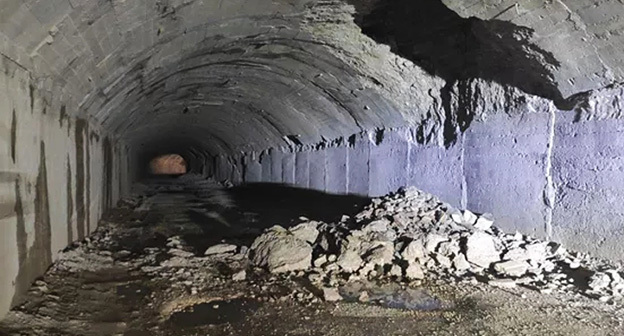
Repair of the tunnel on the road to the Kodori Gorge has begun in Abkhazia for the first time since the Five-Day War in 2008. Regional authorities cited safety concerns as the reason for the repairs.
Repair and restoration work on the tunnel has begun near the village of Lata in the Kodori Gorge.
"Considering the importance and strategic significance of this road, we have decided to begin reconstruction of the tunnel. This is the only road that provides access to Upper Lata. The work will be carried out in two stages. The first stage involves reconstructing the tunnel itself, which was damaged, among other things, by landslides," Apsnypress quoted Abkhazian President Badra Gunba as saying today.
The issue of road reconstruction was raised back in 2008.
According to the publication, Gunba also stated that "if we delay repairs to the tunnel, we could be left without a road connecting with the Kodori Gorge, which is of strategic importance."
“The tunnel and road in the gorge are crucial for ensuring the country's security. Both our units and Russian border guards are stationed in the gorge. The issue of road reconstruction was raised back in 2008, but we couldn't find the funds. Thanks to agreements with our Russian colleagues, we were able to allocate funds for the implementation of this very project,” Gunba said.

The cost of the first stage of road infrastructure reconstruction in the Kodori Gorge will be 205.5 million rubles, with all work scheduled for completion by December 2026, according to TASS.
From November 23 to 28, access to the Kodori Gorge will be completely closed, according to the Abkhazia Capital Construction Department. The restrictions are related to tunnel repairs and the construction of the roadway leading to it, the "ChP-Abkhazia" Telegram channel reported, citing the department.
Gelayev, Georgia's Lost Control, and Plans to Build a Cluster
During the Georgian-Abkhaz War of 1992-93, the Kodori Gorge became the site of a standoff between Abkhaz and Georgian forces and eventually came under Georgian control. Abkhazia regained control of the Kodori Gorge in August 2002, according to a "Caucasian Knot" report on the "Five-Day War" of 2008.
Georgian troops withdrew from the Kodori Gorge with virtually no resistance, a date the Abkhaz remember well, Abkhaz journalist Roin Agrba noted earlier.
“Currently, the Abkhaz authorities are trying to make the eastern part of the republic—which is significantly behind the western part in its socioeconomic development—more attractive for investment. And repairing the road infrastructure in the Kodori Gorge is an integral part of this plan. A mountain tourism cluster is planned for the gorge. The decision to repair the road to the gorge was made during a visit to Abkhazia by a Kremlin curator, Sergei Kiriyenko, a representative of the Russian Presidential Administration,” according to a JAMnews article published on August 9, 2025.
The publication's article also notes that, until 2008, an agreement between Georgia and Abkhazia required regular patrols by UN peacekeeping forces and international observers in the Kodori Gorge. However, due to the inaccessibility of the area, patrols proved ineffective. Incidents occurred regularly in the gorge.
For example, in October 2001, Chechen field commander Ruslan Gelayev and his detachment infiltrated the Kodori Gorge with their forces, attempting to seize strategically important positions. Clashes with Abkhaz forces erupted in the gorge, during which a UN observer helicopter was shot down. Control over the territory was restored only by mid-October.
Emzar Kvitsiani, a Georgian military officer and field commander, formerly the Georgian President's authorized representative in Abkhazia's Kodori Gorge, played a major role in Georgia's control over the Kodori Gorge. According to military experts, Kvitsiani was partially responsible for ensuring that the eastern part of the Kodori Gorge, geographically part of Abkhazia, remained under Georgian jurisdiction after the end of hostilities. According to some reports, Emzar Kvitsiani entered into a gentleman's agreement with the Abkhaz, who subsequently made no attempt to clear the uncontrolled territory, home to approximately 3,000 Svans, according to a biography of Emzar Kvitsiani
Translated automatically via OpenAI from https://www.kavkaz-uzel.eu/articles/417580

![Tumso Abdurakhmanov. Screenshot from video posted by Abu-Saddam Shishani [LIVE] http://www.youtube.com/watch?v=mIR3s7AB0Uw](/system/uploads/article_image/image/0001/18460/main_image_Tumso.jpg "Tumso Abdurakhmanov. Screenshot from video posted by Abu-Saddam Shishani [LIVE] http://www.youtube.com/watch?v=mIR3s7AB0Uw")