

Karabakh refugees consider food aid essential amid cuts in payments
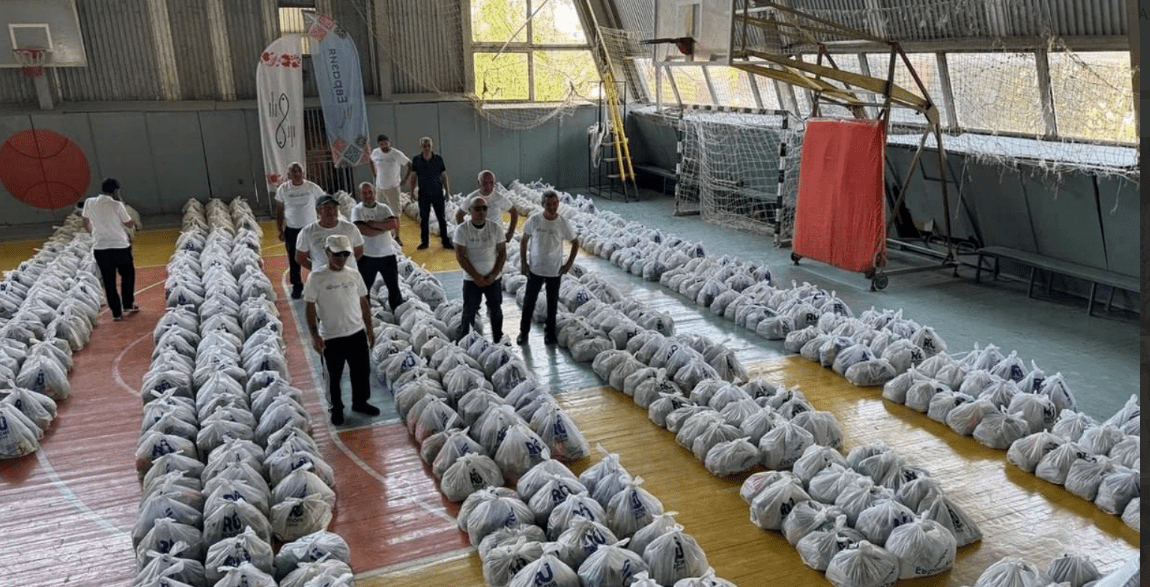
About 3 thousand families of Karabakh refugees received food packages as part of the Russian humanitarian program. Such packages will allow at least temporarily to reduce spending on food amid problems with employment and housing, the displaced persons said.
As "Kavkazsky Uzel" wrote, since August 1, ANO "Eurasia" began providing food aid to refugees from Nagorno-Karabakh living in the regions of Armenia. The campaign was organized within the framework of the "Russia with You" project with the support of ANO "Russian Humanitarian Mission" and Rossotrudnichestvo. By August 12, about 800 refugee families from Nagorno-Karabakh received Russian humanitarian aid. Some residents called it significant support, but some refused it on principle.
For Karabakh refugees in Armenia, the "40+10" program was in effect, under which 40 thousand drams (about $103) were allocated to each refugee for rent and 10 thousand (about $25.8) for utility bills. From April 2025, it was decided not to extend this program to people of working age, but to leave only payments of 30 thousand drams for children under 18, people with disabilities and pensioners. In the spring, the Council for the Protection of the Rights of Citizens of Nagorno-Karabakh achieved an extension of social assistance to refugees for another two months. The authorities do not take into account the realities of life in Armenia and housing prices, said displaced persons interviewed by the "Caucasian Knot".
One of the organizers of the action reported that humanitarian aid was distributed in the communities of Masis and Gyumri - about 3 thousand families received it.
"Since the end of August to this day, it has been distributed in the city of Abovyan. It is planned to visit other cities of Armenia. Assistance is provided to families of internally displaced persons from Nagorno-Karabakh, who are part of a vulnerable group - the disabled, pensioners, large families, families who have lost a breadwinner, families of fallen soldiers. Families apply for assistance on a specially created electronic platform, after which there is a procedure for selecting and verifying data that is entered into the list," the mission representative told the "Caucasian Knot" correspondent.
In the representative office of the Nagorno-Karabakh Karabakh in Yerevan noted that "today this is the only major action providing assistance to refugees in large quantities." "Food aid was provided en masse during the first year of the Artsakh (Karabakh) people's stay in Armenia - at the state level, by humanitarian international missions, funds, private entrepreneurs, but from January 1, 2025, they all stopped," the "Caucasian Knot" correspondent was told at the representative office.
"There is no other such large-scale campaign as the one carried out by Russian organizations for internally displaced persons at the moment. There are small organizations or individuals who have their own target groups to whom they provide assistance, but this is a small number of refugee families, and these organizations prefer not to promote their activities," said the head of the Center for Information, Consultation and Support for Refugees from Nagorno-KarabakhLiana Petrosyan.
She noted that there are three programs of the Armenian government for refugees from Nagorno-Karabakh - these are the provision of certificates for the purchase of housing, financial support for refugees in the vulnerable group - 30 thousand drams per month, and emergency financial assistance for families in the amount of 40 +10 thousand drams if the family income does not exceed 55 thousand drams.
Petrosyan reported that people turn to the Center for consultation on the housing program and employment - to understand the conditions, what rights the employee and employer have.
"Housing and employment remain the main problem for people. After the termination of the "40 + 10 thousand drams for housing rent" program for all refugees, families faced social problems. Therefore, they began to inquire about the possibility of using the state program for providing certificates. At the same time, people are concerned about low salaries, or the inability to find a job. In Armenia, it is possible to find a job only in the service sector. It is possible to find a job in the capital. Therefore, 70% of refugees live in settlements close to the capital, where rent or housing prices are high,” Petrosyan noted.
She added that “there is no program that provides temporary housing to refugees,” the state program for providing social housing to refugees is not yet in effect.
Nune Grigoryan from Stepanakert has two minor children. They rent housing in the city of Abovyan. She said that she received Russian aid as a single mother.
“Our family was given 25 kilograms of different products. This will last us a month. The products are high-quality. This is the first time our family has received so much food at once. This is support for us, since I do not I can’t find a permanent job, I only have part-time jobs. Most of my income goes towards rent. It’s hard to find work in Abovyan, especially for women over 40, but I’m still looking. I’m not thinking about buying a place to live, even with a certificate from the state, since it’s impossible to buy a room in a dorm with the amount that our family of three will receive as a result,” the woman shared.
Anatoly Sargsyan from the Martuni region of Nagorno-Karabakh lives with his wife and mother in the city of Abovyan. They are all pensioners. According to them, the family is in dire need of food aid, since their pension is enough to pay for rent and medicine for their mother and wife. According to him, when they came to the warehouse in the city of Abovyan where Russian aid is distributed, they were told that pensioners would be able to receive it after September 20. He said that he saw food packages that other families received, was happy with the contents, and hoped that his family would also receive what was promised.
"We were provided with such assistance once in 2024, from some international organization. There was also food for a whole month or more. But after the support, there was none," the pensioner said.
The application of the Natalia Petrosyan family for Russian assistance was not accepted. "I understand that vulnerable groups are in need. But all refugee families have social problems, who pay for rent, low salaries, sick people. Our family of six, where there are students, pensioners. We have to pay for housing, for education too, and pensioners need a lot of medicine. "Any help to families like ours, and there are quite a lot of them, is tangible support," she told a "Caucasian Knot" correspondent.
We have updated the applications on Android and IOS! We would appreciate criticism, ideas for development both in Google Play/App Store and on KU pages in social networks. Without installing a VPN, you can read us in Telegram (in Dagestan, Chechnya and Ingushetia - with VPN). Through VPN, you can continue to read "Caucasian Knot" on the website, as usual, and in social networks Facebook*, Instagram*, "VKontakte", "Odnoklassniki" and X. You can watch the "Caucasian Knot" video in YouTube. Send messages to WhatsApp* to +49 157 72317856, to Telegram – to the same number or write to @Caucasian_Knot.
* Meta (which owns Facebook, Instagram and WhatsApp) is banned in Russia.
Translated automatically via OpenAI from https://www.kavkaz-uzel.eu/articles/415334

![Tumso Abdurakhmanov. Screenshot from video posted by Abu-Saddam Shishani [LIVE] http://www.youtube.com/watch?v=mIR3s7AB0Uw](/system/uploads/article_image/image/0001/18460/main_image_Tumso.jpg "Tumso Abdurakhmanov. Screenshot from video posted by Abu-Saddam Shishani [LIVE] http://www.youtube.com/watch?v=mIR3s7AB0Uw")