

The justification for installing a bust of a Chekist interested Volgograd residents
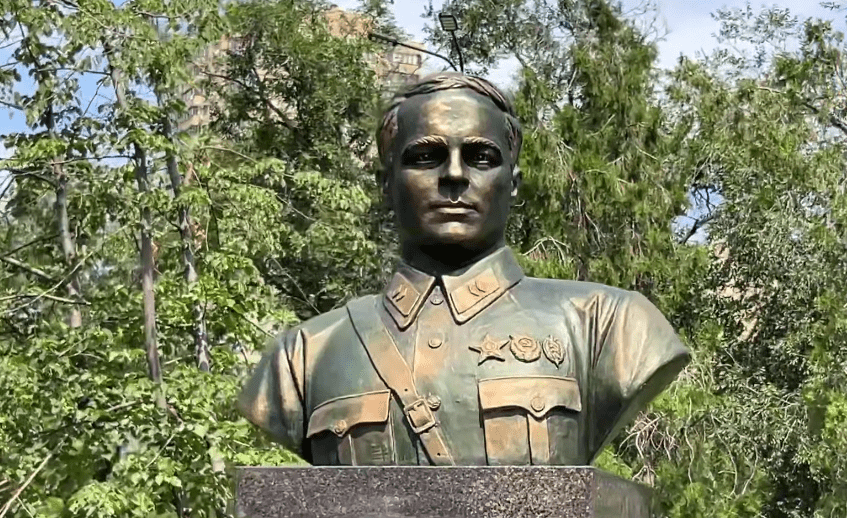
The Volgograd authorities explained the installation of a bust of the head of the Stalingrad Regional NKVD Directorate, Alexander Voronin, by his services in the Great Patriotic War, keeping silent about the mass repressions. Activists and lawyers doubted that the installation of the monument was agreed upon with the residents.
As "Caucasian Knot" wrote, activists of the Volgograd Regional Association of Victims of Political Repressions restored the names of 250 thousand repressed fellow countrymen, the rehabilitation process was completed only by 2016.
On July 17, the day the Battle of Stalingrad began, a monument to Alexander Voronin, who headed the Stalingrad NKVD from 1938 to 1944, was ceremonially unveiled in the Central District of Volgograd.
The question of the legality of erecting a monument to Chekist Voronin in Volgograd will be crystal clear when the most complete information about Stalin's terror in our region is received after his appointment as head of the Stalingrad Regional Directorate of the NKVD in 1938, historian Andrei Kudinov told a "Caucasian Knot" correspondent.
In the 1930s, 250 thousand Stalingrad residents were repressed, of which about 200 thousand were later rehabilitated, he recalled.
"Over the past 30 years, public figures and activists throughout Russia have been able to study and publish lists of those repressed - the so-called books of memory, in 70 regions. The names of more than 2.5 million victims of terror have been restored. The Volgograd Region, alas, is not on this list. It is clear that these lists are incomplete. This work was done by enthusiasts. But a huge amount of research is needed. A state order is needed, with state funding. It is necessary for state archives to provide historians with all the information they have about the repressions. This primarily concerns the FSB archives. The work must be done on a turnkey basis - as fully as possible," said Andrei Kudinov.
The processes of rehabilitation and debunking the crimes of the Stalinist regime were not carried out to the proper extent.
The historian pointed out the incompleteness of the data collected by enthusiasts on the scale of Stalin's repressions throughout the country. Information on the scale of terror in the Stalingrad province in general, according to Kudinov, is scanty.
"The processes of rehabilitation and debunking the crimes of the Stalinist regime were not carried out to the proper extent. The half-heartedness of measures both during the Khrushchev era and in the post-perestroika period led to the fact that we are now witnessing the rehabilitation and justification of the Stalinist regime. This trend is typical for all of Russia, not just Volgograd,” the historian said.
The decision to erect a monument to the hero of the Great Patriotic War is extremely important, said historian Pavel Sizov.
“I have not seen a single study in which Alexander Voronin was convicted of crimes during Stalin’s purges and the implementation of measures aimed against saboteurs and enemies of the people. At the same time, we know a lot about his fruitful and heroic work during the war. Even if there were excesses in his pre-war work, the feat that he accomplished with his subordinates during the years of the fight against fascism more than compensates for his past shortcomings. The man is worthy of the people’s memory,” said Pavel Sizov.
Alexander Voronin was born in 1908 in the Vladimir province, where he graduated Soviet-Party School. After studying at the Central School of the NKVD of the USSR in 1938, Voronin was appointed head of the Stalingrad Regional Directorate of the NKVD. Since 1941, Alexander Ivanovich joined the city defense committee. Under his leadership, the Chekist soldiers were engaged in law enforcement, counterintelligence and reconnaissance and sabotage activities, and also provided assistance in solving economic problems and were engaged in organizing local air defense. During the development of Operation Uranus, under the leadership of Alexander Ivanovich, the Chekists carried out work to disinform the enemy, and after the end of the battle, they also organized work to clear mines from the city, the Volgograd administration cited Voronin's biography in its Telegram channel.
Former deputy of the Volgograd City Duma Ilya Kravchenko did not see parallels with the trends in the installation of the monument to the Chekist Voronin in Volgograd justifications of Stalinism in Russia.
"I am sure there is no connotation with Stalin here. It is just that people of a certain group want to perpetuate the memory of those who are impressed by them. The modern FSB is trying to establish itself in the traditions of the Cheka and NKVD. Although, I am sure that the NKVD officers of the 1930s would not have perceived the FSB officers as their own. So they wanted to erect a monument to a Chekist - they erected one. They did not erect one to scientists and engineers who really make our lives better, not to their FSB officers who died in the North Military District, but to the Chekist Voronin. "It is unknown with what money," Ilya Kravchenko told a "Caucasian Knot" correspondent.
Under Stalin, mass arrests, deportations and executions were carried out on the basis of nationality, entire nations were declared "hostile," according to the "Caucasian Knot" report "10 myths about Stalin's role in the Great Patriotic War."
Lawyer Roman Melnichenko is an active participant in the events of reading the names of those repressed during the years of Stalin's terror, which take place at the monument to the victims of political repression "Leaving for Heaven" in Volgograd. Roman admitted in a conversation with a correspondent that no one in his family was repressed in those years, and his grandfather on his mother's side "served in punitive organs."
Using the example of his grandfather, he emphasized that the installation of monuments to those who participated in the repressions is unacceptable.
"And although he went through the entire war, I would not want a monument to be erected in his honor. Let the memory of my grandfather lie as a burden on me and my descendants. Only crystal-clear people are worthy of public individual memory, let their relatives remember the rest," said Roman Melnichenko.
There was no justification for this decision, no research of archival documents was conducted, and no referendum on the issue of installing the monument took place
Another participant in the memorial events in Volgograd, on condition of anonymity, stated that the installation of a monument to Chekist Voronin in Volgograd was illegal.
"There was no justification for this decision, no research no archival documents were conducted, and no referendum on the issue of erecting a monument took place. They conceived the project quietly, and now they have presented everyone with a fait accompli," the activist said.
He suggested postponing the debate about the "ambivalence" of Voronin's personality (the organizer of mass repressions - a hero of the Great Patriotic War) until a later time.
"The fact that he was involved in mass terror in our region is beyond doubt. The fact that he showed heroism during the war is also an indisputable fact. Should monuments be erected to such controversial personalities now - I am sure that it is too early. Let's first sort out our history and our present," the interlocutor said.
Lawyer Sergey Ivaschenko voiced a number of questions related to the installation of a monument to the Chekist Alexander Voronin in Volgograd.
"What kind of monument is this, what is its status? Is it an object of cultural heritage, a monumental art that should be taken under state protection? Who is its owner? Is this object included in the register of sculptural compositions, memorial complexes, obelisks located on the territory of the region? "Who financed it?" the lawyer asked, noting that he had not yet found any answers to them in the public domain.
Ivaschenko, referring to Article 47.3 of Law No. 73-FZ "On Cultural Heritage Sites (Historical and Cultural Monuments) of the Peoples of the Russian Federation", noted that the owner of the monument is obliged to bear the costs of maintaining the cultural heritage site and maintaining it in proper technical, sanitary and fire-safe condition. At the same time, the lawyer explained that information about the owner of the cultural heritage site can be obtained by requesting an extract from the Unified State Register of Real Estate as part of a public service from the Federal Cadastral Chamber of the Federal Service for State Registration, Cadastre and Cartography.
"If the Voronin monument is not a cultural heritage site, there may not be any legal issues for the owner, but the approval of such construction, for example, with city architects and the cultural heritage protection committee is necessary, due to issues of the so-called aesthetic visualization of urban space and historical justification," said Sergei Ivaschenko.
The lawyer also asked whether the requirements of the state standard are observed when installing monumental structures like the Voronin monument. In particular, should research and scientific survey work be carried out to substantiate design decisions, and are hearings held among local residents.
"Were there any justifications and hearings? If the justification had indicated that the Chekist Voronin was the initiator and organizer of mass repressions in the region, would the local authorities and Volgograd residents have given the go-ahead for the installation of a monument to such a historical figure? ", asked lawyer Sergei Ivaschenko.
Recall that the busts of Stalin, Zhukov and Vasilevsky were unveiled on February 1, 2023, in Volgograd to mark the 80th anniversary of the Battle of Stalingrad. Speakers extolled Stalin's role in the victory and called the townspeople "Stalingraders" a hundred meters from the monument to the victims of political repression, which is adjacent to the bust of the leader. Some Volgograd residents interviewed by the "Caucasian Knot" considered this a restoration of historical memory.
On April 29, Volgograd Region Governor Andrei Bocharov told President Vladimir Putin that the veteran community was asking to rename the Volgograd airport to Stalingrad airport, and Putin signed a corresponding decree on the same day. Renaming the airport fits into a series of conscious and unconscious attempts to rehabilitate Stalin's name, but there is no real public demand for this, according to historians and human rights activists interviewed by the "Caucasian Knot".
The reason for talking about renaming the city again was a slip of the tongue by cadet Regina Sultanova, who was present at Putin's meeting with participants of the "Knowledge. First" marathon on April 30. Sultanova, who is listed as an activist of pro-government organizations (the Volgograd regional public organization "House of Friendship" and the "Voin" center) in the list of meeting participants on the Kremlin website, thanked Putin for "renaming the city." Correcting her, Putin asked: "Do you think that the city should be renamed?" "Yes, because after all, it is connected with a deep history. On behalf of the entire population (I say), we would be very happy," the activist said. Another forum participant said that she joined Sultanova's words "as a Volgograd resident," according to a video of the dialogue published by TASS. Putin promised to "think about" the proposal, noting that he would like to find out the opinion of the majority of city residents.
The official procedure for renaming Volgograd to Stalingrad, which Putin "promised to think about," involves a long series of bureaucratic steps, but can be implemented without a referendum. The final decision on renaming the city of Volgograd to Stalingrad can be made "only by the federal center", since the renaming of administrative centers of Russian regions, according to the federal law "On the names of geographical objects", "is carried out by federal laws", lawyers interviewed by the "Caucasian Knot" noted.
We have updated applications on Android and IOS — now they work without VPN! We would appreciate criticism, ideas for development both in Google Play/App Store, and on KU pages in social networks. Without installing a VPN, you can read us in Telegram (in Dagestan, Chechnya and Ingushetia — with VPN) or use the Ceno browser to bypass blocking. Using VPN, you can continue reading "Caucasian Knot" on the website as usual, and on social networks: Facebook*, Instagram*, "VKontakte", "Odnoklassniki" and X. You can watch the video of "Caucasian Knot" on YouTube. Send messages to WhatsApp* to the number +49 157 72317856, to Telegram - to the same number or write to the address @Caucasian_Knot.
* the activities of the Meta company (which owns Facebook, Instagram and WhatsApp) are prohibited in Russia.
Translated automatically via OpenAI from https://www.kavkaz-uzel.eu/articles/413171

![Tumso Abdurakhmanov. Screenshot from video posted by Abu-Saddam Shishani [LIVE] http://www.youtube.com/watch?v=mIR3s7AB0Uw](/system/uploads/article_image/image/0001/18460/main_image_Tumso.jpg "Tumso Abdurakhmanov. Screenshot from video posted by Abu-Saddam Shishani [LIVE] http://www.youtube.com/watch?v=mIR3s7AB0Uw")